HARPOKRATES
Greek Name
Ἁρποκρατες
Transliteration
Harpokrates
Latin Spelling
Harpocrates
Translation
Harpa-khruti
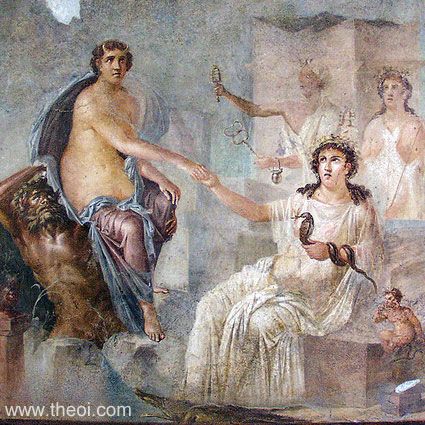
HARPOKRATES (Harpocrates) was the god of silence.
Harpokrates was the Greek interpretation of the Egyptian god Harpa-Khruti (Horus the Child) who was usually depicted as a small boy with a finger held to his lips--an Egyptian gesture symbolising childhood which the Greeks mistook for a hush for silence.
PARENTS
IO-ISIS (Hyginus Fabulae 277)
CLASSICAL LITERATURE QUOTES
Pseudo-Hyginus, Fabulae 277 (trans. Grant) (Roman mythographer C2nd A.D.)
:
"[The Egyptian goddess] Isis first invented sails, for while seeking her son Harpocrates [Horus], she
sailed on a ship."
Ovid, Metamorphoses 9. 688 ff (trans. Melville) (Roman epic C1st B.C. to C1st A.D.)
:
"She saw before her bed, or seemed to see as in a dream, great [Egyptian goddess] Isis with her train of
holy deities. Upon her brow there stood the crescent moon-horns, garlanded with glittering heads of golden
grain, and grace of royal dignity; and at her side . . . [Harpocrates] the god who holds his finger to his lips
for silence's sake."
Ovid, Metamorphoses 9. 692 ff :
"Upon her [the Egyptian goddess Isis'] brow stood the crescent moon-horns, garlanded with glittering heads
of golden grain, and grace of royal dignity; and at her side the baying dog Anubis, dappled Apis, sacred
Bubastis and the god [Harpocrates] who holds his finger to his lips for silence sake."
SOURCES
ROMAN
- Hyginus, Fabulae - Latin Mythography C2nd A.D.
- Ovid, Metamorphoses - Latin Epic C1st B.C. - C1st A.D.
OTHER SOURCES
Other references not currently quoted here: Augustine City of God 18.5, Varro On the Latin Language 5.57, Catullus 102, Erasmus Adages 4.1.52.
BIBLIOGRAPHY
A complete bibliography of the translations quoted on this page.