BESTIARY
The myths and legends of the ancient Greeks were filled with a wide variety of fabulous creatures, monsters, fantastic tribes and demons.
I. SUB-BESTIARIES
II. MONSTERS & CREATURES OF MYTH
OVERVIEW OF THE BESTIARY
The fantastic creatures of Greek mythology and legend can be divided into eight broad categories :
1. MYTHICAL MONSTERS
Awful humanoid creatures. These included monsters such as the Gorgons and Echidna.
2. MYTHICAL HYBRIDS
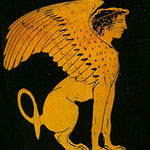
Creatures which combine human and animal forms or various animals. These include creatures such as the Centaur (Horse-Man), Sphinx (Lion-Woman), Hippocamp (Fish-Horse), and Chimaera (Lion-Goat-Snake).
3. MYTHICAL ANIMALS
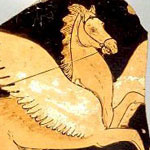
Normal animals with some fantastic attribute. Examples include the winged horse Pegasus, the giant Erymanthian Boar, the fire-breathing Bulls of Colchis, and the inescapable hunting-dog Laelaps.
4. DRAGONS
A breed of serpentine monsters, usually equipped with some magical power. They include creatures such as the Hydra, the Dragon of the Golden Fleece, Python, the Ethiopian Sea-Monster and the she-dragon Echidna.
5. GIANTS
Gigantic men, often with fantastic features or abilities. A few examples are the hundred-handed Hecatoncheires, the one-eyed Cyclopes, the water-walking hunter Orion, the wrestler Antaeus, and the monstrous Typhon.
6. GHOSTS & DEMONS
Creatures from the underworld which haunted the earth. They included the Empusae, Erinyes, Vampires and haunting ghosts of the dead.
Fantastic animals which were believed to inhabit the remote corners of the earth. They included the Manticore, Unicorn (Greek Monoceratus), Catoblepas, and Griffin.
Fabulous tribes of men which were believed to inhabit the lands of Terra Incognita, the "Unknown Earth." Examples of these are the Pygmies, the one-legged Sciapods, dog-headed Cynocephali, headless Blemmyae, and one-eyed Arimaspians.
BESTIARY
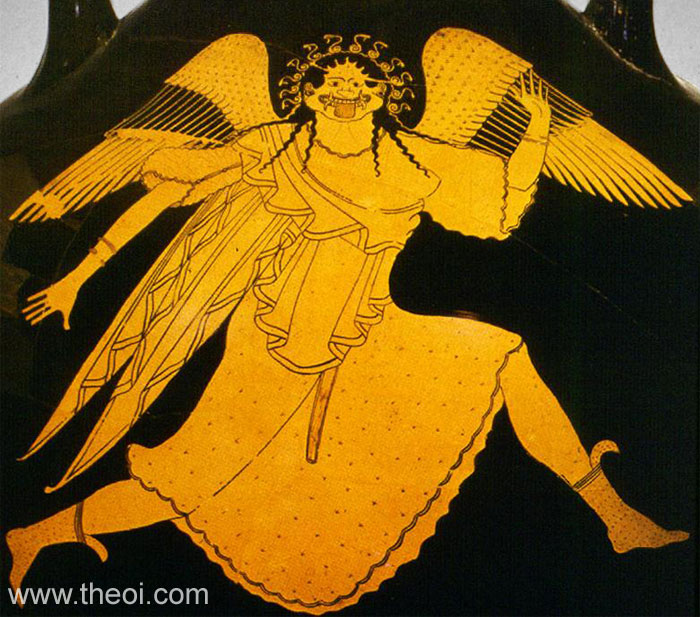
Greek myth and legend is filled with a wide variety of monsters and creatures ranging from Dragons, Giants, Demons and Ghosts, to multiformed creatures such as the Sphinx, Minotaur, Centaurs, Manticores and Griffins. There were also many fabulous animals such as the Nemean Lion, golden-fleeced Ram and winged horse Pegasus, not to mention the creatures of legend such as the Phoenix, Unicorns (Monocerata). Even amongst the tribes of man, myth spoke of strange peoples inhabiting the far reaches of the earth such as the hopping Umbrella-Foots, the one-eyed Arimaspians, the Dog-Headed men, and the puny Pygmies.
AMPHISBAENAE see Beasts, African
AUTOMOTONS (Automotones) Creatures crafted out of metal and endowed with life by the smith-god Hephaestus.
- BULLS, BRONZE (Tauroi Khalkeoi) Four fire-breathing, bronze bulls which Hephaestus crafted for King Aeetes of Colchis.
- CELEDONES (Keledones) Golden singing maidens which Hephaistos crafted for the first temple of Apollo at Delphi.
- DOGS, GOLD & SILVER (Kuones Khryseos Argyreos) A pair of gold and silver dogs which Hephaestus crafted for King Alcinous of the Phaeacians.
- HORSES, CABEIRIAN (Hippoi Kabeirikoi) A pair of metallic, fire-breathing horses owned by the twin Cabiri gods.
- MAIDENS, GOLDEN (Kourai Khryseai) Four golden maidens which Hephaestus crafted as his own attendants.
- TALOS A bronze giant which Hephaestus crafted for Queen Europa of Crete to patrol the borders of her island.
BASILISCS see Beasts, African
BEASTS, AFRICAN (Theres Aithiopes) The semi-legendary land of Ethiopia (Sub-saharan Africa) was the home of many fabulous beasts.
- AMPHISBAENAE (Amphisbainai) Saharan snakes with two heads, one at each end of the body.
- BASILISCS (Basiliskoi) Deadly serpents which killed by touch.
- BULLS, ETHIOPIAN (Tauroi Aithiopikoi) Gigantic African bulls whose red hides were impervious to steel.
- CATOBLEPAS (Katoblepon) African hoofed animals whose downward looking head, when raised, could kill man with a gaze or with its noxious breath.
- DRAGONS, ETHIOPIAN (Drakones Aithiopikoi) Gigantic African serpents.
- LEUCROCOTAE (Leukrokota) An animals with a powerful jaw of bone in place of teeth, which could imitate human voices to lure it prey.
- PEGASI, ETHIOPIAN (Pegasoi Aithiopikoi) The winged horses of Ethiopia who had a single horn growing from their forehead.
- SATYRS, ISLAND (Satyroi Nesioi) Ape-like satyrs native to certain islands off the African coast.
- SATYRS, LIBYAN (Satyroi Libyes) Monkey-like satyrs who lived in the forest of Mount Atlas.
- SPHINXES, ETHIOPIAN (Sphinxes Aithiopikoi) Women-headed African lions.
BEASTS, INDIAN (Theres Indikoi) Legendary India was the home of many fabulous beasts.
- ANTS, INDIAN (Myrmekes Indikoi) Gigantic ants which guarded the gold-fields of the Indian desert.
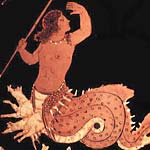
- CETEA, INDIAN (Ketea Indikoi) Fabulous half-animal, half-fish sea-monster such as fish-tailed lions, bears, wolves, rams and even spiny-haired mermaids.
- DRAGONS, INDIAN (Drakones Indikoi) Giant Indian serpents which preyed on elephants.
- MONOCERATA (Hippoi Monokerata) The unicorns, magical single-horned equines native to India.
- WORMS, INDOS Gigantic white worms which inhabited the Indos river.
BEASTS, PERSIAN & ARABIAN (Theres Persikoi) Various fabulous animals were believed to inhabit the lands of Arabia and Persia. See also Manticore and Phoenix.
- SERPENTS, WINGED (Ophies Pteretoi) Feathery-winged serpents of Arabia which guarded the valuable myrrh fields.
BIRDS, OF ARES (Ornithes Areioi) Arrow-shooting birds which guarded the Amazonian shrine of the god Ares.
BIRDS, STYMPHALIAN (Ornithes Stymphalides) Man-eating which haunted lake Stymphalus in Arkadia. Heracles weas sent to drive them away as one of his Labours
BOAR, CALYDONIAN (Hus Kalydonios) A gigantic Aetolian boar slain by a band of heroes in the famed Calydonian Boar Hunt.
BOAR, CLAZOMENEAN (Hus Klazomenaios) A gigantic winged sow which ravaged the island of Clazomenae.
BOAR, CROMMYONIAN (Hus Krommyon) A gigantic sow which ravaged the region of Crommyon. It was slain by the hero Theseus.
BOAR, ERYMANTHIAN (Hus Erymanthios) A gigantic Arcadian boar which Heracles was sent to fetch as one of his twelve labours.
BULL, CRETAN (Tauros Kretaios) The bull which impregnated Pasiphae queen of Crete and which Heracles was sent to fetch as one of his labours.
BULL, OF EUROPA (Tauros Europaios) A bull which carried the Phoenician princess Europa across the sea to Crete. It was sometimes depicted as a fish-tailed animal.
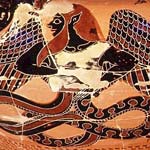
BULL, SERPENT (Tauros Ophis) A black-skinned monster with the foreparts of a bull and the rearparts of a serpent. It was slain by the Sea-Titan Aegaeon during the Titan-War.
CATOBLEPAS see Beasts, African
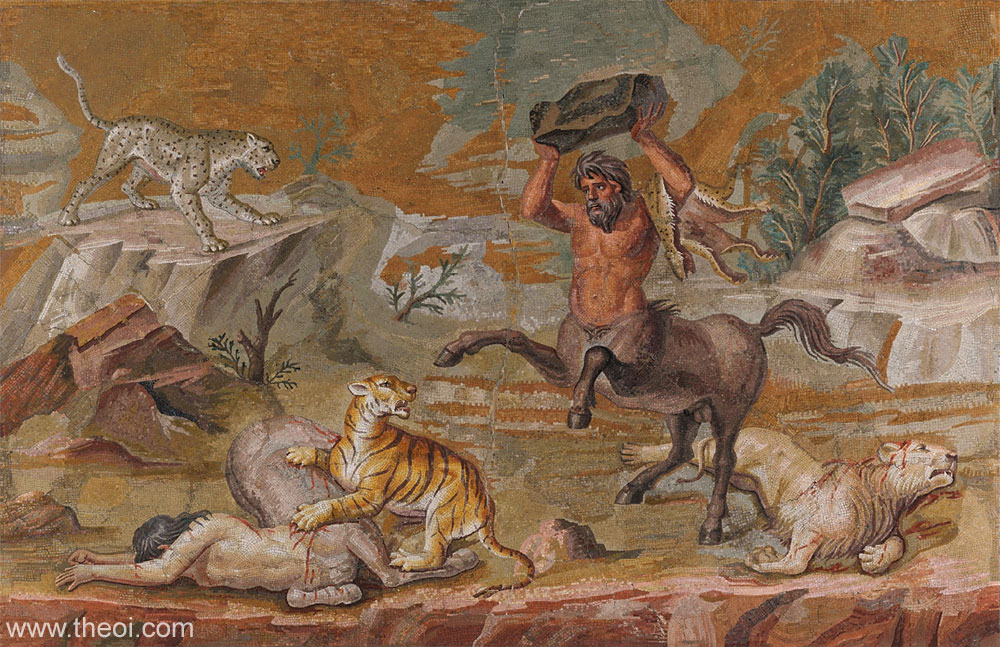
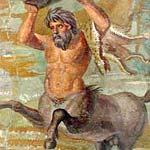
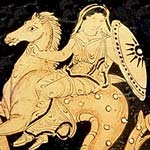
CENTAURS (Kentauroi) A tribe of creatures who had the heads and torsos of men and the bodies of horses.
- CENTAURIDES (Kentaurides) The female centaurs, women with the bodies of horses in place of legs.
- CENTAURS, CYPRIAN (Kentauroi Kyprioi) A tribe of centaurs native to the island of Cyprus.
- CENTAURS, DIONYSIAN (Kentauroi Lamoi) The centaur attendants of the god Dionysos.
- CENTAURS, PELOPONNESIAN (Kentauroi Peloponnesioi) A tribe of Arcadian centaurs which battled Heracles for the wine of Pholus.
- CENTAURS, THESSALIAN (Kentauroi Thessalioi) A tribe of Magnesian centaurs who battled the Lapith tribesmen at the wedding of King Pirithoos.
- CHIRON (Kheiron) A wise, immortal Centaur, half-brother of Zeus. He was the mentor of many Greek heroes.
- EURYTION 1 A Thessalian centaur who tried to abduct the bride of King Pirithoos.
- EURYTION 2 A Pelopennesian centaur slain by Heracles.
- ICHTHYOCENTAURS (Ikhthyokentauroi) Two marine centaurs, named Bythos and Aphros, with the upper torsoes of a men and the lower bodies of hippocamps (fish-tailed horses).
- NESSUS (Nessos) A centaur slain by Heracles.
- PHOLUS (Pholos) A goodly centaur who entertained Heracles.
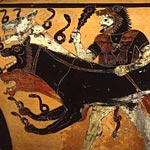
CERBERUS (Kerberos) The three-headed, giant hound that guarded the gates of Hades. It had lion's feet, a mane of serpents and the tail of a viper.
CERCOPES (Kerkopes) A pair of mischievous monkey-like dwarfs.
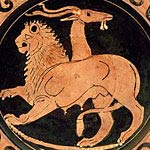
CHIMERA (Khimaira) A three headed monster, with the foreparts of a lion, the hind-parts of a goat and goat's-head rising from its back, and the tail of a headed-serpent.
CRAB, GIANT (Karkinos) A giant crab which fought alongside the Hydra against Heracles.
DEER, CERYNITIAN (Elaphos Kerynitis) A golden-horned deer which Heracles was sent to fetch as one of his twelve labours.
DEER, GOLDEN-HORNED (Elaphoi Khrysokeroi) Five immortal golden-horned deer sacred to the goddess Artemis. Four of them drew the goddess' chariot.
DEMONS (Kakodaimones) Some of the personified spirits and demons of the underworld were monstrous in appearance.
- ACHLYS (Akhlys) The demon of misery was a pale green hag with bleeding cheeks and tear-stained eyes, overgrown fingernails and dusty hair.
- EMPUSA (Empousa) A flame-haired vampiric demon with a leg of bronze and a hoofed foot of an ass. Disguised as a beautiful woman she seduced men to feed on their flesh and blood.
- EURYNOMUS (Eurynomos) A blue-black skinned demon of the underworld who fed on the flesh of corpses.
- KERES Dark-winged death demons which haunted the battlefields of men and fed on the blood of dying men. They were pale ugly hags with clawed hands and gnashing teeth.
- LIMOS The demon of hunger was a starved, wasted creature with parchment skin, and swollen joints.
- MELINOE A spectral underworld demon who issued forth from the underworld to terrify men. One side of her body was ink-black and the other bone-white.
- ZELUS (Zelos) The demon of jealousy was a monstrous hag that fed upon venomous serpents. Her body was shrunken, her teeth black, and her breasts covered in green venom.
DOG, GOLDEN (Kuon Khryseos) A golden hound which Rhea sent to guard the infant Zeus and his nurse the goat Amaltheia.
DOG, LAELAPS (Kuon Lailaps) A fabulous dog destined always to catch its mark.
DOG, ORTHROS (Kuon Orthros) A two-headed, serpent-tailed dog which guarded the cattle of Geryon. It was slain by Heracles.
DRACAENAE (Drakainai) Female-monsters with the head and torsos of women and serpentine-tails in place of legs.
- CAMPE (Kampe) A monstrous Tartarean dracaena who had the body of a woman and a serpent's tail. Her head was wreathed in snakes and her serpentine body was arrayed with a thousand snake's tails for feet. She was armed with a giant scorpion's sting, black wings and around her waist were arrayed the heads of fifty wild beasts.
- DRACAENA, POINE (Drakaina Poine) A monstrous child-devouring she-dragon sent by Apollo to punish the men of Argos.
- DRACAENA, SCYTHIAN (Drakaina Skythia) A Scythian dracaena who seduced Heracles and bore him three sons.
- ECHIDNA 1 (Ekhidna) An immortal Cicilian dracaena who mated with the monstrous giant Typhon and bore a brood of the most fearsome of monsters.
- ECHIDNA 2 (Ekhidna) A monstrous she-serpent which ravaged Argos.
- SYBARIS A Lamia demon which preyed on the men of Phocis.
DRAGONS (Drakones) A race of giant, toothed serpentine monsters.
- DRAGON, COLCHIAN (Drakon Kolkhios) A gigantic Colchian dragon which guarded the famed golden-fleece.
- DRAGON, HESPERIAN (Drakon Hesperia) A hundred headed dragon which guarded the golden apples of the Hesperides.
- DRAGON, LYDIAN (Drakon Maionios) A Lydian dragon slain by the giant Damasen.
- DRAGON, THEBAN (Drakon Ismenios) A monstrous Theban dragon slain by the hero Cadmus. From its earth-sown teeth were sprung a race of fully-grown, armed warriors.
- DRAGON, THESPIAN (Drakon Thespiakos) A dragon which plagued the town of Thespia.
- DRAGONS, MEDEAN (Drakones Medea) A pair of winged serpents which drew the chariot of the witch Medea.
- DRAGONS, TROJAN (Drakones Troiades) A pair of monstrous sea-serpents sent by Poseidon to destroy Laocoon and his sons.
- PYTHON A monstrous serpent that guarded the shrine of Delphi.
EAGLE, CAUCASIAN (Aetios Kaukasios) A gigantic Caucasian eagle which fed on the liver of the chained Titan Prometheus.
EAGLE, OF ZEUS (Aetos Dios) A gigantic golden eagle, the animal familiar of Zeus.
FISHES, OF APHRODITE (Ikhthyes) Two large fish which carried the goddess Aphrodite ashore following her sea-birth.
FOX, TEUMESSIAN (Alopex Teumesios) A gigantic fox which ravaged the kingdom of Thebes, preying upon the unfortunate children of the country.
GIANTS (Gigantes) A breed of oversized, mostly monstrous men.
- AGRIUS & OREUS (Agrios, Oreios) A pair of man-eating Giants who were half man, half bear.
- ALCYONEUS (Alkyoneus) The King of the Giants who was immortal within his homeland of Pallene. Herakles wounded him and dragged him incapacitated from his country to die.
- ALOADAE (Aloidai) Twin giants who tried to storm Olympus by piling three mountains one upon the other. They were slain by the gods.
- ANTAEUS (Antaios) A Libyan giant who drew his strength from the earth. He lifted and strangled to death by Heracles.
- ARGUS PANOPTES (Argos Panoptes) A giant whose body was covered with eyes. He was slain by Hermes.
- CACUS (Kakos) A fire-breathing Italian giant slain by Heracles.
- CYCLOPES, ELDER (Kyklopes) Three one-eyed giants who forged the weapons of the gods.
- CYCLOPES, YOUNGER (Kyklopes) A tribe of cannibalistic giants who shepherded flocks of sheep on the isle of Sicily.
- DAMASEN A gigantic Lydian hero.
- ECHIDNADES (Ekhidnades) A serpent-legged giant slain by Ares.
- ENCELADUS (Enkelados) A fire-breathing giant burried by Athena beneath Mount Etna.
- GEGENEES A tribe of six-armed Mysian giants which were slain by the Argonauts.
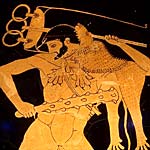
- GERYON A winged giant three-bodied giant. He was slain by Heracles.
- GIGANTES, HECA- The one hundred giants of Phlegra who waged war on the gods. They were led by Alcyoneus, Porphyrion and Enceladus.
- HECATONCHEIRES (Hekatonkheires) Three hundred-handed, fifty-headed giants who guarded the gates of Tartarus.
- HYPERBOREAN GIANTS (Gigantes Hyperboreioi) Three gigantic sons of Boreas the god of the North Wind who were immortal priests of the virtuous Hyperborean tribe.
- LAESTRYGONES (Laistrygones) A race of man-eating giants.
- ORION A handsome giant who could walk on water.
- POLYPHEMUS (Polyphemos) The greatest of the younger Cyclopes. He was blinded by Odysseus.
- TALUS (Talos) A bronze giant who patrolled the island of Crete.
- TITYUS (Tityos) A giant who tried to rape the goddess Leto and was sent to eternal punishment in Hades.
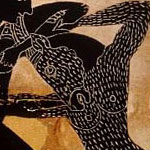
- TYPHON (Typhoeus) A monstrous giant with one human and ninety-nine animal heads, two hundred hands each tipped with fifty serpents, a pair of serpent tails for legs, giant wings, and a fire-breathing maw. He was buried beneath Mt Etna by Zeus.
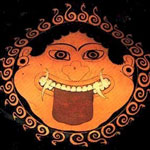
GORGONS (Gorgones) Three monstrous Libyan sisters with broad faces, staring eyes, flaring nostrils, wiry beards, tusks and protruding tongues. Their heads were wreathed in snakes, a pair of golden wings sprung from their backs, and in place of hands they had brazen claws.
GRAEAE (Graiai) Three old hags born with grey hair, wrinkled skin and only one tooth and one eye between them.
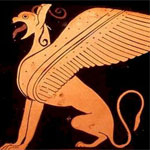
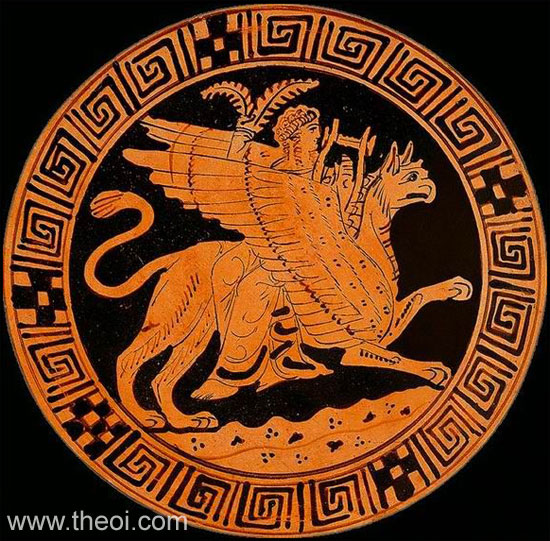
GRIFFINS (Grypes) Winged beasts with the foreparts of eagles and the bodies of lions.
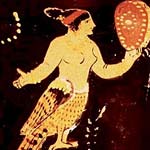
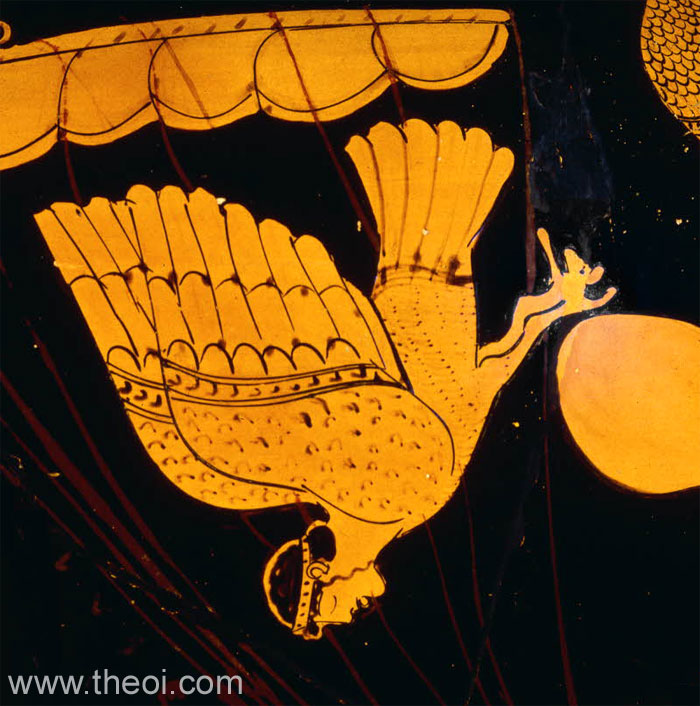
HARPIES (Harpyiai) Three winged monsters with the bodies of birds and the heads and torsos of women.
HIPPALEKTRYON (Hippalektryon) A creature with the fore-parts of the rooster and the body of a horse.
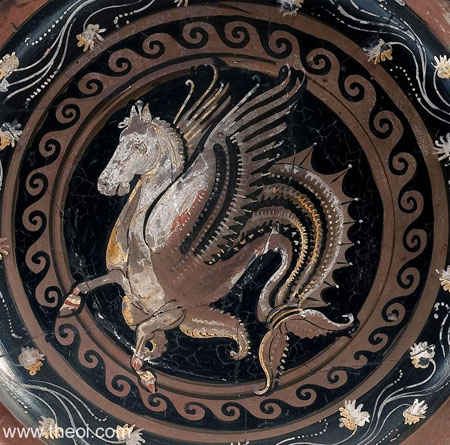
HIPPOCAMPI (Hippokampoi) Sea-creatures with the fore-parts of horses and the tails of serpentine fish.
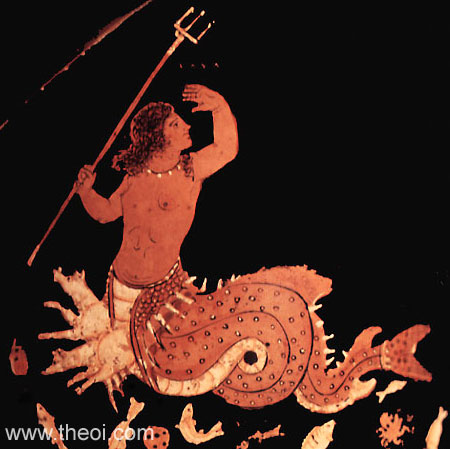
HORSES, IMMORTAL (Hippoi Athanatoi) A breed of swift-footed, immortal horses.
- ARION (Areion) The immortal horse of the hero Adrastus.
- BALIUS & XANTHUS (Balios, Xanthos) Two immortal horses owned by the hero Achilles.
- HORSES, OF ARES (Hippoi Areioi) Four fire-breathing horses which drew the chariot of Ares.
- HORSES, OF DIOMEDES (Hippoi Diomedios) Four man-eating horses owned by the Thracian King Diomedes. Heracles was sent to fetch them as one of his twelve labours.
- HORSES, TROJAN A herd of immortal horses owned by the kings of Troy.
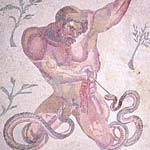
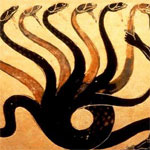
HYDRA (Hydra) The nine-headed serpent of Lerna who sprung two heads for every one which was decapitated. It was slain by Heracles.
LEUCROCOTAE See Beasts, African
LION, NEMEAN (Leon Nemeios) A gigantic Argive lion whose skin was impervious to weapons. It was strangled by Heracles.
MANTICORE (Mantikhoras) A winged Persian monster with the head of a man, the body of a lion and a spiked missile-throwing tail.
MEN, EARTH-BORN (Anthropoi Autokhthonoi) Unusual men sometimes sprouted from the earth itself.
- CECROPS (Kekrops) An earth-born king of Athens who had the tail of a serpent in place of legs.
- SPARTI (Spartoi) A race of earth-born warriors, which sprang fully grown, armed and ready for battle from the sown teeth of a dragon.
MEDUSA (Medousa) A mortal Gorgon slain by Perseus.
MEN, FANTASTIC Races of strangely-formed men were believed to inhabit the farthest reaches of the earth.
- ARIMASPIANS (Arimaspoi, Monommatoi) A tribe of one-eyed men who battled the eagle-headed Griffins for their gold.
- ARTABATITAE (Artabatitai) An African tribe of four-legged men.
- ASTOMI (Astomoi) A hair-covered Indian tribe of men without mouths, who sustained themselves on the scent of aromatic plants.
- BLEMMYAE (Blemmyai, Sternophthalmoi) A tribe of headless African men whose faces were set upon their chests.
- CALINGI (Kalingoi) A short-lived Indian tribe who reached maturity at five and died of old age at eight.
- CHOROMANDAE (Khromandai) A hair-covered Indian tribe, with dog's teeth and a horrible scream in place of speech.
- CUNOCEPHALI (Kunokephaloi, Hemikunes) A tribe of dog-headed African men.
- GORGADES An African tribe whose women were entirely covered in hair.
- HIPPOPODES A northern European tribe with horse's feet.
- MACHLYES (Makhlyes) A Libyan tribe whose bodies were female on one side and male on the other.
- MACROBI (Makroboi) Long-lived Indian tribes never touched by old age.
- MACROCEPHALI (Makrokephaloi) A tribe of African men with long, elongated heads.
- MANDI (Mandoi) A race of Indians who grew old and wrinkled shortly after birth.
- NULI (Nuloi) An African people with backward-turned, eight-toed feet.
- PANDAE (Pandai) A tribe of long-lived Indian men with gigantic ears, eight fingers and toes, and white-hair covering their bodies which turned black with age.
- PANOTII (Panotioi) A fabulous tribe of northern men with gigantic, body-length ears.
- PYGMIES (Pygmaioi) A tribe of one and a half foot tall African men who rode goats into battle against migrating cranes.
- SCIAPODS (Skiapodes, Steganopodes) A tribe of one-legged Libyan men who used their gigantic foot as shade against the midday sun.
- SCIRITAE (Sikiritai) An Indian race with snake-like nostrils in place of a nose, and bandy serpentine legs.
- STRUTHOPODES (Strouthopodes) An Indian tribe whose men had 18 inch long feet and whose women had tiny sparrow-like ones.
- SYRBOTAE (Syrbotai) A tribe of twelve-foot tall Africans.
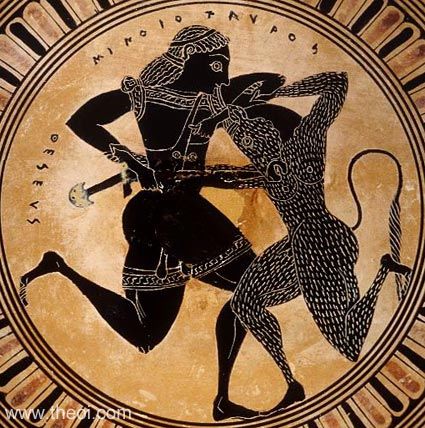
MINOTAUR (Minotauros) A Cretan monster with the head of a bull and the hairy body of a man.
NEADES Gigantic animals native to the island of Samos whose roar could split apart the ground.
PANES A tribe of nature-spirits which had the heads and torsos of men, the legs and tails of goats, goatish faces and goat-horns.
- AEGIPAN (Aigipan) A demi-god with the fore-parts of a goat and the tail of a fish.
- PAN The goat-legged, horned god of shepherds and flocks.
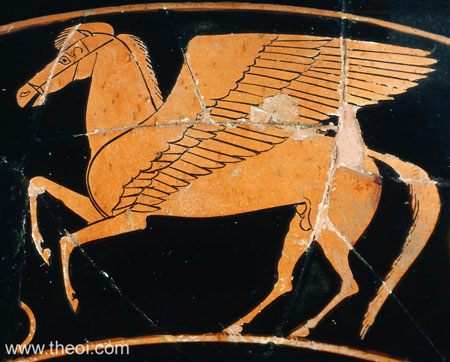
PEGASUS (Pegasos) A winged horse tamed by the hero Bellerophon and ridden into battle with the Chimera.
PHASMA Ghosts or phantoms which haunted the living. Some were corporeal in form, retaining their physical bodies, others were merely bodiless spirits.
- GHOST, PHILINNION A dead Macedonian woman who rose up from her tomb at night to haunt a handsome young guest of her parents. She was probably a lamia (vampire).
- GHOST, POLYCRITUS (Polykritos) A dead man who rose up from his grave and devoured his living hermaphroditic son.
- LAMIAE (Lamiai) Vampiric demons whichy preyed on young men in the guise of a beautiful woman and drank their blood.
- LAMIA CORINTHIAN (Lamia Korinthia) A vampiric Lamia who disguised herself as a wealthy Phoenician woman in order to seduce a handsome young man and drain his blood.
- LAMIA LIBYAN (Lamia Libys) A vampiric Libyan demon which preyed on children. She could pluck out her own bleeding eyes.
- PHANTOMS, EIDOLONES Evil man-possessing spirits or ghosts.
- PHANTOM, EPHESIAN PLAGUE (Eidos Loimos Ephesios) A plague-bringing demon that haunted the town of Ephesus.
- TARAXIPPI (Taraxippoi) Horse-frightening ghosts or daemones which haunted the race-courses of Olympia, Nemea and the Isthmus.
PHOENIX (Phoinix) A fabulous golden-red bird whose feathers shone with the light of the sun.
PYGMIES See Men, fantastic
RAM, GOLDEN-FLEECED (Krios Khrysomallos) A flying, talking, golden-fleeced Ram who rescued the children Phrixus and Helle from a sacrifice to the gods.
RIVER GODS & DAEMONES (Theoi Daimones Potamoi) The river-gods appeared either as men from the chest upwards, set upon the serpentine tail of a fish and crowned with a single bull's horn, or as horned man-headed bulls.
- ACHELOUS (Akheloios) An Aetolian river-god who was wrestled by Heracles.
- OCEANUS (Okeanos) The god of the great earth-encircling river Ocean. He had the tail of a serpentine fish and a bull's horn on his head.
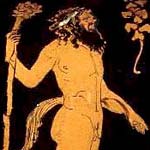
SATYRS (Satyroi) A tribe of nature-spirits with the body of men, the tails of horses, pug noses and the ears of asses.
- MARSYAS A satyr defeated by Apollo in a musical contest.
- SATYR, ETHIOPIAN (Satyros Aithiopikos) A phantom satyr which plagued an African town.
- SATYR, LEMNIAN (Satyros Lemnios) A satyr which consorted with a woman of the island of Lemnos.
- SILENI (Seilenoi) A race of elderly Satyrs with the bodies of old-men, pug-noses, the tails of horses, and asses' ears.
- SILENUS (Seilenos) An elderly Satyr companion of Dionysus.
SCORPION (Skorpios) A giant scorpion sent by Gaea to slay the giant Orion.
SEA GODS & SEA DAEMONS (Daimones Einalioi, Theoi Einalioi) Many of sea-gods appeared as fish-tailed mermen, or were otherwise fabulous in form.
- CHARYBDIS (Kharybdis) A sea daemon whose inhalations formed a deadly whirlpool.
- DELPHIN (Delphin) An immortal dolphin attendant of Poseidon.
- EURYNOME A mermaid-like sea-goddess with the tail of a fish in place of legs.
- GLAUCUS (Glaukos) A blue-skinned, green-haired, fish-tailed sea-god.
- NEREUS An elderly sea-god with the coiled tail of a fish in place of legs.
- SCYLLA (Skylla) A monstrous sea-dracaena with the upper body of a beautiful nymphe, the serpentine-tail of a sea-monster and sprung from her waist a ring of six dog foreparts.
- TELCHINES (Telkhines) Sea-demons with the heads of dogs and flippers of seals in place of hands.
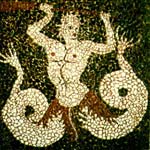
- TRITON A sea-god with either a single or a pair of serpentine fish-tails in place of legs.
- TRITONES A race of sea daemones with the upper bodies of men and the tails of fish. Some were fearsome, scaly monsters with sharp carnivore teeth.
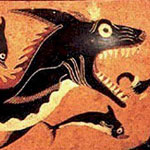
SEA MONSTERS (Ketea) A race of gigantic, serpentine sea-dragons.
- SCOLOPENDRA (Skolopendra) A gargantuan sea-monster with hair extending from its nostrils, a flat crayfish-like tail and rows of webbed feet lining each of its flanks.
- SEA MONSTER, ETHIOPIAN (Ketos Aithiopios) A sea-monster killed by Perseus.
- SEA MONSTER, TROJAN (Ketos Troios) A sea-monster slain by Heracles.
SHEEP, GOLDEN (Melai Khryseoi) A flock of aggressive and highly poisonous, golden-fleeced sheep.
SIRENS (Seirenes) Three winged sea-monsters whose irresistable song lured sailors to their deaths. They had the heads (or heads and torsos) of women and the bodies of birds.
SPHINX A Theban monster with the head of a woman and the body of a lioness.
TURTLE, GIANT A giant turtle preyed on the men cast into the sea by the bandit Sciron.
UNICORNS Fabulous Indian horses with a single magical horn. The Greeks called them Monocerata (One-Horned) which the Romans translated as Unicorni.