EURYTION
Greek Name
Ευρυτιων
Transliteration
Eurytiôn
Latin Spelling
Eurytion
Translation
Fine-Flowing
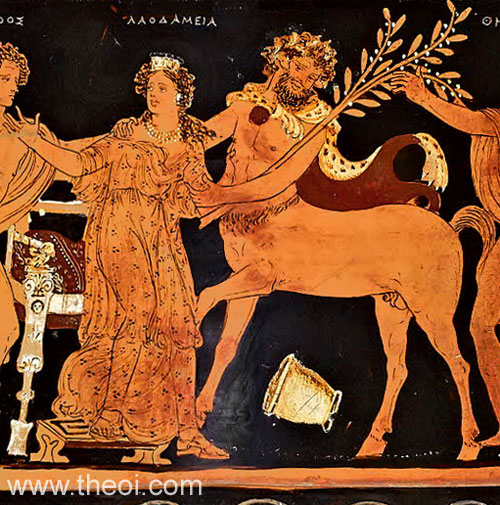
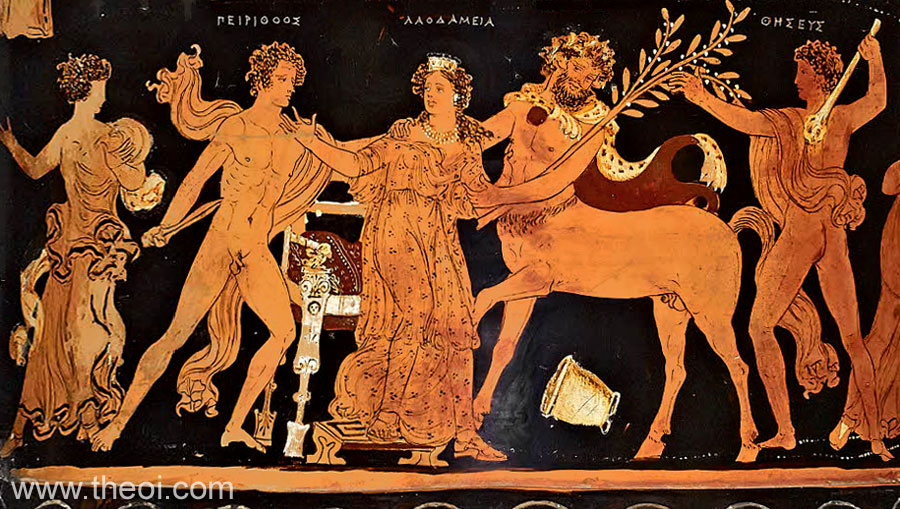
EURYTION was the leader of the half-horse, half-man Magnesian Kentauroi (Centaurs). He was invited to the wedding of his half-brother Peirithoos (Pirithous), king of the Lapithai (Lapiths), but during the celebrations became drunk and attempted to abduct the bride. In the fight which ensued Eurytion and his Kentauroi kin were slain.
The drunken kentauros was fittingly named Eurytion, "Fine-Flowing" or Eurytos "Fine Drinking-Horn" from the Greek words eu- "fine" and rhytos "drinking-horn".
The Arkadians had their own myth about a kentauros named Eurytion who, like his Thessalian counterpart tried to take a bride by force.
PARENTS
IXION & NEPHELE, like the other Kentauroi
ALTERNATE NAME SPELLINGS
Greek Name
Ευρυτος
Transliteration
Eurytos
Latin Spelling
Eurytus
Translation
Fine Drinking-Horn
CLASSICAL LITERATURE QUOTES
Homer, Odyssey 21. 293 ff (trans. Shewring) (Greek epic C8th B.C.) :
"Wine is many a man's undoing, when he gulps his draught and will never drink discreetly. Wine it was that
darkened the wits of Eurytion the Kentauros (Centaur) in the palace of bold Peirithoos (Pirithous). The
Kentauros had come to the Lapithai's (Lapiths') country, and now with wine he clouded his understanding and in
his frenzy did monstrous things in the very hall of Peirithoos. The heroes were seized with indignation; they
leapt up, they dragged the Kentauros across the courtyard and out of doors, they lopped off his ears and nose
with the ruthless bronze, and the frenzied creature went his way, taking his retribution with him in his still
darkened mind. From this beginning came the long feud between men and Kentauroi (Centaurs), but it was Eurytion
first of all who brought chastisement on himself by his drunkenness."
Pausanias, Description of Greece 5. 10. 8 (trans. Jones) (Greek travelogue C2nd A.D.)
:
"[Amongst the scenes depicted on the pediment of the temple of Zeus at Olympia :] Carved on the pediment is
the fight between the Lapithai (Lapiths) and the Kentauroi (Centaurs) at the marriage of Peirithoos (Pirithous).
On one side of him is Eurytion, who has seized the wife of Peirithous, with Kaineus (Caeneus) bringing help to
Peirithoos."
Athenaeus, Deipnosophistae 1. 10e (trans. Gullick) (Greek rhetorician C2nd to C3rd
A.D.) :
"By way of denouncing drunkenness the poet [Homer] portrays the Kyklops (Cyclops) [Polyphemos], for all his
great size, as completely overcome, when drunk, by a small person; likewise the kentauros (centaur)
Eurytion."
Ovid, Metamorphoses 12. 210 ff (trans. Melville) (Roman epic C1st B.C. to C1st A.D.)
:
"Ixion's son [Peirithoos (Pirithous)] had wed Hippodame (Hippodameia) and called the cloud-born beasts
(feri nubigeni) [i.e. the Centaurs] to recline at tables ranged within a tree-clad cave. The Haemonii
(Lords of Thessaly) were there and I [Nestor] was there myself. The festive palace rang with the merry hubbub of
the milling guests. And now the wedding hymn was sung, the fires smoked in the royal hall, in came the bride
with wives and matrons walking at her side, supreme in beauty. Blessed indeed we called Pirithous with such a
bride--and brought, nearly, thereby their wedded bliss to naught! For Eurytus, the fiercest of the fierce
Centauri (Centaurs), was fired by wine and by the sight of that fair girl, and drink was in command, double by
lust. Tables were overturned, the banquet in confusion, and the bride, held by her hair, was seized and carried
off. Hippodame was seized by Eurytus; the others seized what girl each would or could. The scene was like a city
sacked; the house echoed with women's screams. At once we all sprang to our feet and Theseus shouted first
‘What madness, Eurytus, possesses you to provoke Pirithous while I'm alive--two men, you fool, in
one!’
To back his words the great-souled prince, thrusting the throng aside, rescued the ravished girl from their wild
rage. No answer came; for no words could defend such deeds. The dastard charged her champion, pummelled his
noble chest and punched his chin. An antique wine-bowl chanced to stand near by, jagged with high relief; huge
as it was, Aegides [Theseus] still huger lifted it and hurled it crashing on his foe. He vomited great gouts of
blood with brains and wine from wound and throat, and falling backwards beat his heels upon the soaking sand.
His death incensed his twiformed brothers and with one accord, each vying with the rest, ‘To arms, to
arms!’ They shouted. Wine gave courage. In the first fighting goblets went flying and fragile jars and
bowls and dishes meant for banqueting, now turned to war and carnage."
Propertius, Elegies 2. 33c (trans. Goold) (Roman elegy C1st B.C.) :
"You, too, centaurus (centaur) Eurytion, were undone by wine."
SOURCES
GREEK
- Homer, The Odyssey - Greek Epic C8th B.C.
- Pausanias, Description of Greece - Greek Travelogue C2nd A.D.
- Athenaeus, Deipnosophistae - Greek Rhetoric C3rd A.D.
ROMAN
- Ovid, Metamorphoses - Latin Epic C1st B.C. - C1st A.D.
- Propertius, Elegies - Latin Elegy C1st B.C.
BIBLIOGRAPHY
A complete bibliography of the translations quoted on this page.