TITYROI
Greek Name
Τιτυρος Τιτυροι
Transliteration
Tityros, Tityroi
Latin Spelling
Tityrus, Tityri
Translation
Of the Flute (tityrinos)
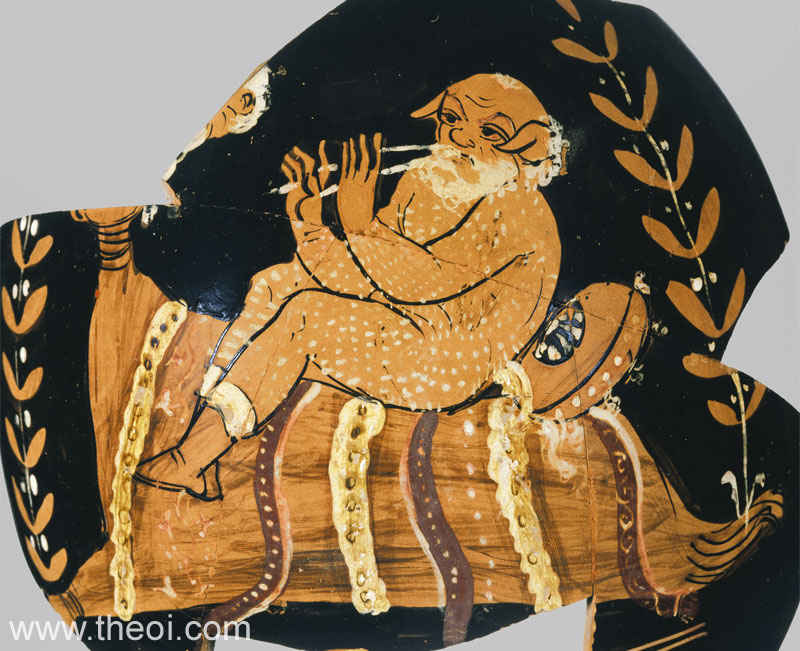
THE TITYROI (Tityri) were flute-playing, rustic daimones in the train of the god Dionysos. They were closely related to the Satyroi (Satyrs), Seilenoi (Silens) and Lenai (Lenae), and like those daimones were depicted as small, furry men with assine ears, pug noses and tails.
The name Tityros was derived from the Greek word tityrinos, a double shepherd's pipe. According to Eustathius (1157. 39) Tityros was simply the Doric word for satyr. There was also a Mount Tityros near Kydonia (Cydonia) in Krete (Crete). The bucolic poets often use the name Tityros for a rustic character in their poems.
The Boeotian giant Tityos, who attempted to violate the goddess Leto and was slain by Apollon, may have been have originally been a Tityros. The satyr Marsyas could also be classified as one.
PARENTS
Probably the same as the Satyroi, though nowhere stated
CLASSICAL LITERATURE QUOTES
TITYRI AS SATYRS
Strabo, Geography 10. 3. 7 (trans. Jones) (Greek geographer C1st B.C. to C1st A.D.)
:
"The Satyroi (Satyrs), Silenoi (Silens), Bakkhai (Bacchae), and Tityroi (Tityri) . . . are called Daimones
or ministers of gods."
Strabo, Geography 10. 3. 10 :
"The [daimones called] Silenoi (Silens) and Satyroi (Satyrs) and Bakkhai (Bacchae), and also the Lenai
(Lenae) and Thyiai (Thyiae)and Mimallones and Naïdes Nymphai (Naiad Nymphs) and the beings called Tityroi
(Tityri), [are attendants] of Dionysos."
Strabo, Geography 10. 3. 15 :
"They [the poets] also invented some of the names by which to designate the ministers, choral dancers, and
attendants upon the sacred rites [of Rhea and Dionysos], I mean Kabeiroi (Cabeiri) and Korybantes (Corybantes)
and Panes and Satyroi (Satyrs) and Tityroi (Tityri)."
Aelian, Historical Miscellany 3. 40 (trans. Wilson) (Greek rhetorician C2nd to 3rd
A.D.) :
"Note that Dionysos' companions in the dance were Satyroi (Satyrs), called by some Tityroi (Tityri). They
received this name from the trills (teretismata) which the Satyroi enjoy, and the Saytroi got their
name from the word ‘to grimace’ (sesêrenô)." [N.B. These etymologies are
late inventions.]
TITYRUS AS RUSTICS
The bucolic poets sometimes use the name Tityros for a rustic in their poems. There are numerous examples, including:-
Theocritus, Idylls 3. 1 ff (trans. Edmonds) (Greek bucolic C3rd B.C.) :
"I go a-courting of Amyrallis, and my goats they go browsing on along the hill with Tityros (Tityrus) [here
a rustic] to drive them on. My well-beloved Tityros, pray feed me my goats; pray lead them to watering, good
Tityros, and beware or the buckgoat, the yellow Libyan yonder, will be butting you."
Virgil, Eclogues 1. 1 (trans. Fairclough) (Roman bucolic C1st B.C.) :
"You, Tityrus [here a rustic], lie under the canopy of a spreading beech, wooing the woodland Muse on
slender reed, but we are leaving our country's bounds and sweet fields . . . Tityrus, at ease beneath the shade
teach the woods to re-echo ‘fair Amaryllis.’"
TITYUS OF EUBOEA
The giant Tityos (Tityus) of the island of Euboia resembes a Tityros.
Homer, Odyssey 7. 324 (trans. Shewring) (Greek epic C8th B.C.) :
"That is the furthest point [the island of Euboia (Euboea)] of all--so say those of our people who once set
eyes on it when they carried yellow-haired Rhadamanthys to visit Tityos son of Gaia (Gaea, the Earth)."
Strabo, Geography 9. 3. 14 (trans. Jones) (Greek geographer C1st B.C. to C1st A.D.)
:
"And a cave called Elarion is to be seen in the island [of Euboia], named after Elara the mother of Tityos;
and also a hero-temple of Tityos, and certain honors which are paid to him."
ANCIENT GREEK ART
T50.1 Tityrus-Silen Playing Flute
Sicilian Red Figure Vase Painting C4th B.C.
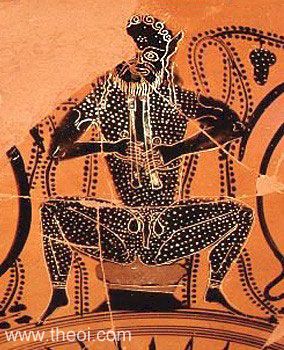
T60.4 Tityrus-Satyr Playing Flute
Athenian Black Figure Vase Painting C6th B.C.
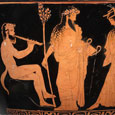
K12.4 Tityrus-Satyr & Dionysus
Athenian Red Figure Vase Painting C5th B.C.
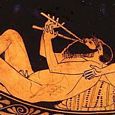
T60.14 Tityrus-Satyr & Dionysus
Athenian Red Figure Vase Painting C5th B.C.
SOURCES
GREEK
- Homer, The Odyssey - Greek Epic C8th B.C.
- Theocritus, Idylls - Greek Idyllic C3rd B.C.
- Strabo, Geography - Greek Geography C1st B.C. - C1st A.D.
- Aelian, Historical Miscellany - Greek Rhetoric C2nd - 3rd A.D.
ROMAN
- Virgil, Eclogues - Latin Bucolic C1st B.C.
BIBLIOGRAPHY
A complete bibliography of the translations quoted on this page.