HIPPOI DIOSKOURIOI
Greek Name
Ἱπποι Διοσκουριοι
Transliteration
Hippoi Dioskourioi
Latin Spelling
--
Translation
Horses of the Dioscuri
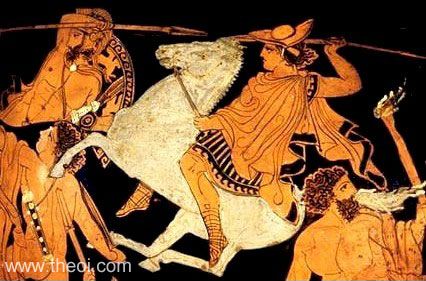
THE HIPPOI DIOSKOUROI (Horses of the Dioscuri) were four immortal steeds gifted to the Dioskouroi by the gods Hermes and Hera. They served the twins both during their time on earth and after their ascension to godhood. The horses were named Kyllaros, Xanthos, Phlogeus and Harpagos.
FAMILY OF THE HORSES
PARENTS
[1.1] ZEPHYROS & PODARGE (Stesichorus Frag 178)
NAMES
[1.1] KYLLAROS, XANTHOS (Alcman Frag 25)
[1.2] KYLLAROS, XANTHOS, PHLOGEUS, HARPAGOS (Stesichorus Frag 178)
[1.3] KYLLAROS (Virgil Georgics 3.89, Seneca Phaedra 810, Valerius Flaccus 1.426, Statius Thebaid 6.328)
OFFSPRING OF KYLLAROS
[1.1] ASKHETOS, KYGNOS (Statius Thebaid 6.328)
ENCYCLOPEDIA
CY′LLARUS (Kullaros). The horse of Castor was called Cyllarus. (Virg. Georg. iii. 90; Val. Flacc. i. 426; Suidas, s. v.)
Source: Dictionary of Greek and Roman Biography and Mythology.
CLASSICAL LITERATURE QUOTES
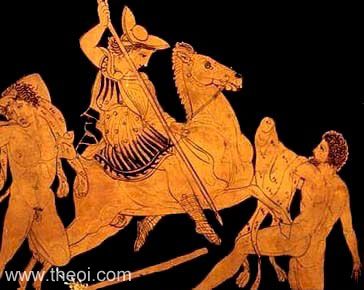
Alcman, Fragment 25 (from Scholiast on Virgil, Georgics) (trans. Campbell, Vol. Greek Lyric II) (C7th B.C.) :
"The horses given to Hera by Poseidon are called Kyllaros (Cyllarus) and Xanthos (Xanthus) by the lyric poet Alkman (Alcman) : Kyllaros was said to have been given to Polydeukes (Polydeuces), Xanthos to his brother."
Stesichorus, Fragment 178 (from Etymologicum Magnum) (trans. Campbell, Vol. Greek Lyric III) (C7th to 6th B.C.) :
"Stesichorus in his Funeral Games of Pelias says that Hermes gave the Dioskouri (Dioscuri) Phlogeus and Harpagos, swift foals of [the Harpyia (Harpy)] Podarge, while Hera gave them Xanthos and Kyllaros (Cyllarus)."
[N.B. The Dioskouroi were here competing in the chariot-races of the funeral games of Pelias.]
Virgil, Georgics 3. 89 ff (trans. Fairclough) (Roman bucolic C1st B.C.) :
"[On the finest of horses :] Such was Cyllarus, tamed by the reins of Amyclaean Pollux, and those whose fame Greek poets recount, the two steeds of Mars [Ares], and the pair of the great Achilles."
Seneca, Phaedra 810 (trans. Miller) (Roman tragedy C1st A.D.) :
"Shouldst thou be pleased to ride a horn-footed horse, with hand more agile on the rein than Castor’s thou couldst guide the Spartan Cyllarus."
Valerius Flaccus, Argonautica 1. 426 ff (trans. Mozley) (Roman epic C1st A.D.) :
"[Castor] left [his horse] Cyllarus to fatten upon the grass of Amycle [i.e. when he boarded the ship of the Argonauts]."
Statius, Thebaid 6. 328 ff (trans. Mozley) (Roman epic C1st A.D.) :
"[Amphiaraus enters the chariot-race of the first Nemean Games :] Amphiaraus, next favourite for the prize, aloft in his chariot drives Oebalian steeds; thy progeny, Cyllarus [i.e. one of the horses of the Dioscuri], stealthily begotten while far away by the mouth of Scythian Pontus Castor was exchanging for the oar the Amyclean rein. Snow-white his own raiment, snow-white are the coursers that lend their necks to the yoke, his [Amphiaraus'] helm and fillet match the whiteness of his crested plume . . .
[During the race] neither goads nor lashes now suffice, but with shout of name does . . . the Danaan augur [Amphiaraus] chide fleet Aschetos and Cygnus well so-called . . .
[Apollon] lends strength and refreshment [to the horses of Amphiaraus]; swifter than the East wind he flies, as though the barrier were just fallen and he were starting on the race, and calling aloud on nimble Caerus and snow-white Cygnus, plies their necks with blows and shakes the reins upon their backs [and won the race]."
NAMES OF THE HORSES OF THE DIOSCURI
Greek Name
Κυλλαρος
Ξανθος
Φλογευς
Ἁρπαγος
Transliteration
Kyllaros
Xanthos
Phlogeus
Harpagos
Latin Spelling
Cyllarus
Xanthus
Phlogeus
Harpagus
Translation
Crooked? (kyllos)
Bay (xanthos)
Flaming (phlogeus)
Hook (harpagos)
ANCIENT GREEK ART
H28.1 Dioscurus Riding Horse
Athenian Red Figure Vase Painting C4th B.C.
H28.1B Dioscurus Riding Horse
Athenian Red Figure Vase Painting C4th B.C.
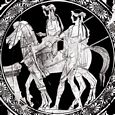
H28.2 Dioscuri Twins & Horse
Athenian Red Figure Vase Painting C5th B.C.
SOURCES
GREEK
- Greek Lyric I Alcman, Fragments - Greek Lyric C7th B.C.
- Greek Lyric III Stesichorus, Fragments - Greek Lyric C7th - 6th B.C.
ROMAN
- Virgil, Georgics - Latin Bucolic C1st B.C.
- Seneca, Phaedra - Latin Tragedy C1st A.D.
- Valerius Flaccus, The Argonautica - Latin Epic C1st A.D.
- Statius, Thebaid - Latin Epic C1st A.D.
BIBLIOGRAPHY
A complete bibliography of the translations quoted on this page.