TYKHON & ORTHANES
Greek Name
Τυχων
Κονισαλος
Ορθανης
Transliteration
Tykhôn
Konisalos
Orthanês
Latin Spelling
Tychon
Conisalus
Orthanes
Translation
Producer, Chance
Lascivious One
Erect-One (orthoô)
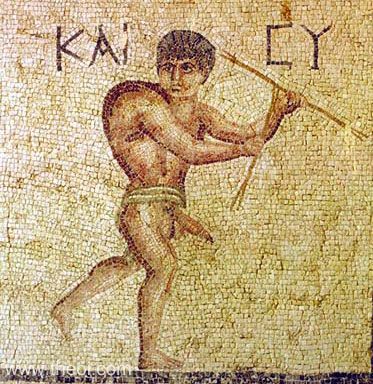
TYKHON (Tychon), KONISALOS (Conisalus) and ORTHANES were three, rustic fertility-spirits (daimones)--phallic deities, similar to satyrs, depicted with erect members.
They were probably associated with the phallic processions of the god Dionysos or else the phallic statues (hermai) of Hermes. The daimon Phales and Phrygian god Priapos were closely related.
PARENTS
Probably HERMES or DIONYSOS, though nowhere stated
ENCYCLOPEDIA
CONISALUS (Konidalos), a daemon, who together with Orthanes and Tychon appeared in the train of Priapus. (Aristoph. Lys. 983; Athen. x. p. 441 Strab. xiii. p. 588; Hesych. s. v.)
TYCHON (Tuchôn). 1. A god of chance or accident. was, according to Strabo (ix. D. 408), worshipped at Athens. (Comp. Anthol. Palat. ix. 334.) 2. An obscene daemon, is mentioned as a companion of Aphrodite and Priapus, and seems to signify "the producer," or "the fructifier." (Etym. Magn. and Hesych. s. v.)
Source: Dictionary of Greek and Roman Biography and Mythology.
ALTERNATE NAME SPELLINGS
Greek Name
Ορηθανης
Ορθαγης
Ορθαγενης
Transliteration
Orêthanês
Orthagês
Orthagenês
Latin Spelling
Orethanes
Orthages
Orthagenes
Translation
Erect One
Erect One
Erect Born (genos)
CLASSICAL LITERATURE QUOTES
Aristophanes, Lysistrata 983 ff (trans. O'Neill) (Greek comedy C5th to 4th B.C.)
:
"[An Athenian magistrate speaks :] ‘Are you a man or a Konisalos (Conisalus) [phallic daimon],
pray?’"
Strabo, Geography 13. 1. 12 (trans. Jones) (Greek geographer C1st B.C. to C1st A.D.)
:
"It was by people of later times that [the phallic daimon] Priapos (Priapus) was declared a god, for even
Hesiod does not know of him; and he resembles the Attic deities Orthannes (Orthanes), Konisalos (Conisalus),
Tykhon (Tychon), and others like them."
SOURCES
GREEK
- Aristophanes, Lysistrata - Greek Comedy C5th - 4th B.C.
- Strabo, Geography - Greek Geography C1st B.C. - C1st A.D.
OTHER SOURCES
Other references not currently quoted here: Athenaeus 10.441, Hesychius, Choerob. in Theod 1.274.
BIBLIOGRAPHY
A complete bibliography of the translations quoted on this page.