HALIAI
Greek Name
Ἁλια Ἁλιαι
Transliteration
Halia, Haliai
Roman Name
Nymphae Marini
Translation
Of the Sea (halia)
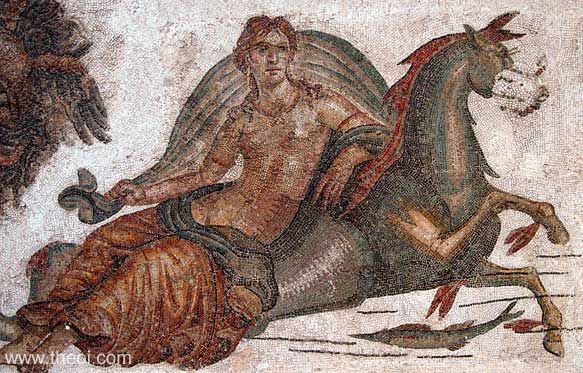
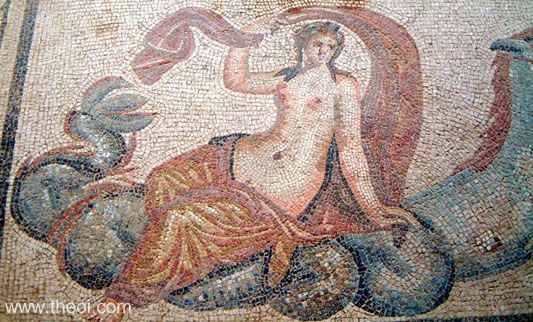
HALIAI (Haliae) were the nymphs of the sea. They were depicted as beautiful maidens often riding through the sea on the backs of hippokampoi (fish-tailed horses) and dolphins.
FAMILY OF THE HALIAE
PARENTS
THE SEA-GODS (Various sources)
ENCYCLOPEDIA
HA′LIA (Halia). One of the Nereides (Hom. Il. xviii. 42; Apollod. i. 2. § 6); but the plural, Haliae, is used as a name for marine nymphs in general. (Soph. Philoct. 1470; Callim. Hymn. in Dian. 13.)
Source: Dictionary of Greek and Roman Biography and Mythology.
LIST OF NAMED HALIAE
AMPHITRITE One of the Nereides and the wife of Poseidon, King of the Sea.
ARGYRA A sea-nymph loved by the hero Selemnos.
BENTHESIKYME (Bethesicyme) A sea-nymph daughter of Poseidon and wife of Enalos king of Aithiopia (Ethiopia).
EIDOTHEA A sea-nymph daughter of Proteus.
GALATEIA (Galatea) A Nereid loved by the Kyklops Polyphemos (Cyclops Polyphemus).
HALIA A sea-nymph daughter of Pontos loved by Poseidon.
KABEIRO (Cabeiro) A sea-nymph daughter of Proteus loved by Hephaistos (Hephaestus).
KALLISTE (Calliste) A sea-nymph daughter of Triton and goddess of the island of Kalliste (Calliste).
KYMOPOLEIA (Cymopoleia) A sea-nymph daughter of Poseidon and the wife of the Hekatonkheir Briareos (Hecatoncheir Briareus).
LEUKOTHEA (Leucothea) A mortal woman and nurse of Dionysos who was transformed into a sea-nymph upon her death.
NEREIDES, THE (Nereids) The fifty sea-nymph daughters of Nereus, the Old Man of the Sea.
PALLAS A sea-nymph daughter of Triton and companion of the goddess Athene.
PSAMATHE The Nereid wife of the sea-god Proteus.
RHODE A sea-nymph daughter of Poseidon, wife of Helios, and goddess of the island of Rhodes.
SKYLLA (Scylla) A sea-nymph daughter of Phorkys (Phorcys) who was transformed into a monster by the witch Kirke (Circe).
THETIS The Nereid wife of the hero Peleus.
THOOSA A sea-nymph daughter of Phorkys loved by Poseidon.
TRITEIA A sea-nymph daughter of Triton loved by Ares.
TRITONIDES Sea-nymph daughters of the marine god Triton.
TRITONIS A sea-nymph daughter of Triton and goddess of the salt-lake Tritonis of Libya.
ALTERNATE NAMES
Greek Name
Ἁλιας Ἁλιαδες
Ειναλιαι Θαλασσαι
Transliteration
Halias, Haliades
Einaliai Thalassai
Roman Name
Nymphae Marini
Nymphae Pelagi
Translation
Of the Sea (halia)
Nymphs of the Sea
CLASSICAL LITERATURE QUOTES
Sophocles, Philoctetes 1470 ff (Greek tragedy C5th B.C.) :
"Chorus : Come let us go now all together, and pray to the Nymphai Haliai (Sea-Nymphs) to grant us a
prosperous voyage."
Pausanias, Description of Greece 7. 23. 1 (trans. Jones) (Greek travelogue C2nd A.D.)
:
"Argyra, they say, was a Nymphe Thalassa (Sea-Nymph)."
Orphic Hymn 24 to the Nereides (trans. Taylor) (Greek hymns C3rd B.C. to 2nd A.D.)
:
"[The Nereides] fifty inspired Nymphai Einalioi (Nymphs of the Sea), who through the main delight to follow
in the Tritones' train, rejoicing close behind their ars to keep; whose forms half wide are nourished by the
deep, with other Nymphai of different degree, leaping and wandering through the liquid sea. Bright, watery
dolphins, sonorous and gay, well-pleased to sport with Bacchanalian play; Nymphai beauteous-eyed, whom sacrifice
delights, give plenteous wealth, and bless our mystic rites."
Ovid, Metamorphoses 13. 736 ff (trans. Melville) (Roman epic C1st B.C. to C1st A.D.)
:
"Many a suitor sought her [the sea nymphe Skylla's] hand, but she repulsed them all and went to the Nymphae
Pelagi (Sea-Nymphs), she was the Nymphae's favourite, and told how she'd eluded all the young men's love."
Statius, Silvae 3. 1. 144 ff (trans. Mozley) (Roman poetry C1st A.D.) :
"The very Nymphae (Nymphs) of the green waters leap forth unbidden from their pumice caves; they cling to
the streaming rocks nor think shame to gaze unseen on the naked wrestlers [of the Games]."
Statius, Silvae 2. 2. 102 ff :
"Often in autumn-time when the grapes are ripening, a Nereis (Nereid) [here probably meaning a sea-nymph in
general] climbs the rocks, and under cover of the shades of night brushes the sea-water from her eyes with a
leafy vine-spray, and snatches sweet clusters from the hills. Often is the vintage sprinkled by the neighbouring
foam; Satyri (Satyrs) plunge into the waters, and Panes from the mountain are fain to grasp the Sea-Nympha as
she flies naked through the waves."
Catullus, Carmina 64. 103 ff (Roman poetry C1st A.D.) :
"And then on that propitious day [the sailing of the first ship] mortal eyes gazed on the Nymphae Marini
(Nymphs of the Sea) with naked bodies bare to the breasts outstanding from the foamy swirl."
ANCIENT GREEK & ROMAN ART
Z33.9 Sea-Nymph Riding Hippocamp
Greco-Roman Carthage Floor Mosaic C3rd A.D.
Z33.9B Sea-Nymph Riding Monster
Greco-Roman Carthage Floor Mosaic C3rd A.D.
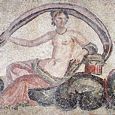
Z33.3 Sea-Nymph Riding Hippocamp
Greco-Roman Antioch Floor Mosaic C3rd A.D.
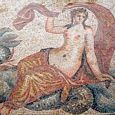
Z33.5 Sea-Nymph Riding Hippocamp
Greco-Roman Ephesus Floor Mosaic A.D.
SOURCES
GREEK
- Sophocles, Philoctetes - Greek Tragedy C5th B.C.
- Pausanias, Description of Greece - Greek Travelogue C2nd A.D.
- The Orphic Hymns - Greek Hymns C3rd B.C. - C2nd A.D.
ROMAN
- Ovid, Metamorphoses - Latin Epic C1st B.C. - C1st A.D.
- Cattulus, Carmina - Latin Poetry C1st B.C.
- Statius, Silvae - Latin Poetry C1st A.D.
OTHER SOURCES
See individual Nymph pages.
BIBLIOGRAPHY
A complete bibliography of the translations quoted on this page.