HEPHAISTOS GOD OF
Greek Name
Ἡφαιστος
Transliteration
Hêphaistos
Latin Spelling
Hephaestus
Translation
Vulcan
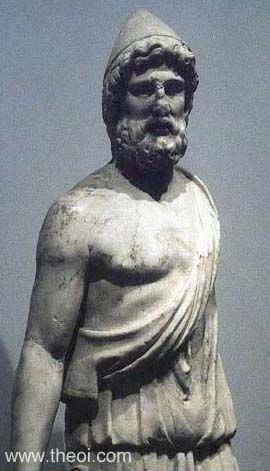
HEPHAISTOS was the Olympian god of fire, smiths, craftsmen, metalworking and stonemasonry.
This page describes the divine roles and functions of the god--including fire, smiths and craftsmen, volcanoes and his identification with foreign gods.
CLASSICAL LITERATURE QUOTES
GOD OF FIRE
Hephaistos was the god of fire, and often his name was used as a synonym for the element.
Homer, Iliad 2. 426 ff (trans. Lattimore) (Greek epic C8th B.C.) :
"[The men] pitted the vitals and held them [to cook] over the flame of Hephaistos."
Homer, Iliad 9. 467 ff :
"Swine with the fat abundant upon them were singed and stretched out across the flame of Hephaistos."
Homer, Iliad 17. 88 ff :
"Looking like the flame of Hephaistos, weariless."
Homer, Iliad 23. 33 ff :
"[Sacrificial animals were] stretched out across the flame of Hephaistos."
Homer, Odyssey 24. 71 ff (trans. Shewring) (Greek epic C8th B.C.) :
"When the flame of Hephaistos had consumed you [the dead man on the funeral pyre]."
Hesiod, Theogony 864 ff (trans. Evelyn-White) (Greek epic C8th or 7th B.C.)
:
"Tin melts when heated by men's art in channelled crucibles; or as iron, which is hardest of all things, is
softened by glowing fire in mountain glens and melts in the divine earth through the strength of
Hephaistos."
Homeric Hymn 4 to Hermes 115 ff (trans. Evelyn-White) (Greek epic C7th to 4th B.C.)
:
"The strength of glorious (klytos) Hephaistos was beginning to kindle the [sacrificial]
fire."
Aeschylus, Agamemnon 281 ff (trans. Smyth) (Greek tragedy C5th B.C.) :
"Hephaistos [i.e. as the fire of the beacons], from Ida speeding forth his brilliant blaze. Beacon passed
beacon on to us by courier-flame: Ida, to the Hermaean crag in Lemnos; to the mighty blaze upon the island
succeeded, third, the summit of Athos sacred to Zeus."
Aeschylus, Prometheus Bound 7 ff :
"[Kratos to Hephaistos:] Your own flower, flashing fire, source of all arts, he [Prometheus] has purloined
and bestowed upon mortal creatures . . . Why do you not detest a god most hateful to the gods, since he has
betrayed your prerogative [fire] to mortals?"
Aristophanes, Birds 436 ff (trans. O'Neill) (Greek comedy C5th to 4th B.C.)
:
"Here, you there, take all these weapons and hang them up inside close to the fire, near the figure of the
god who presides there and under his protection."
Quintus Smyrnaeus, Fall of Troy 4. 440 ff (trans. Way) (Greek epic C4th A.D.)
:
"As a cauldron on Hephaistos' hearth maddens with ceaseless hissing o'er the flames from blazing billets
coiling round its sides."
Quintus Smyrnaeus, Fall of Troy 13. 170 ff :
"The hot flesh of the swine whereon the red breath of Hephaistos beat."
Quintus Smyrnaeus, Fall of Troy 13. 367 ff :
"The flames gave back before him everywhere: the blast of Hephaistos' breath."
Quintus Smyrnaeus, Fall of Troy 4. 160 ff :
"Hephaistos purest flame of fire [at the wedding of Peleus and Thetis for the cooking of the feast]."
Orphic Hymn 66 to Hephaestus (trans. Taylor) (Greek hymns C3rd B.C. to 2nd A.D.)
:
"Strong, mighty Hephaistos, bearing splendid light, unwearied fire, with flaming torrents bright:
strong-handed, deathless, and of art divine, pure element, a portion of the world is thine: all-taming artist,
all-diffusive power, 'tis thine, supreme, all substance to devour: aither, sun, moon, and stars, light pure and
clear, for these thy lucid parts [of fire] to men appear. To thee all dwellings, cities, tribes belong, [fire]
diffused through mortal bodies, rich and strong."
Plato, Cratylus 400d & 407c (trans. Fowler) (Greek philosopher C4th B.C.)
:
"[Plato constructs philosophical etymologies for the names of the gods :]
Sokrates : Let us inquire what thought men had in giving them [the gods] their names . . . The first men who
gave names [to the gods] were no ordinary persons, but high thinkers and great talkers . . .
Hermogenes : But surely you, as an Athenian, will not forget Athena, nor Hephaistos and Ares . . . And how do
you explain Hephaistos?
Sokrates : You ask about ‘the noble master of light’? . . . Hephaistos is Phaistos, with
the eta added by attraction; anyone could see that, I should think."
Ovid, Metamorphoses 9. 262 ff (trans. Melville) (Roman epic C1st B.C. to C1st A.D.)
:
"Whatever parts the flames could ravage Mulciber [Hephaistos] had removed."
Ovid, Metamorphoses 12. 61 ff :
"The selfsame god [Hephaistos] had armed him [Akhilleus] and consumed him in the end [on the pyre]."
Seneca, Medea 824 ff (trans. Miller) (Roman tragedy C1st A.D.) :
"[The witch Medea employs various fabulous ingredients in a spell to create magical fire :] Mulciber
[Hephaistos] hath also given me fires which subtly lurk in sulphur."
Suidas s.v. Hephaistos (trans. Suda On Line) (Byzantine Greek lexicon C10th A.D.)
:
"Hephaistos : The god and fire."
For MYTHS of Hephaistos as the god of fire see:
(1) Hephaestus & the Chaining of Prometheus
(2) Hephaestus Battles the River-God Scamander
(3) Hephaestus Favour: Cabeiri
GOD OF SMITHS & CRAFTSMEN
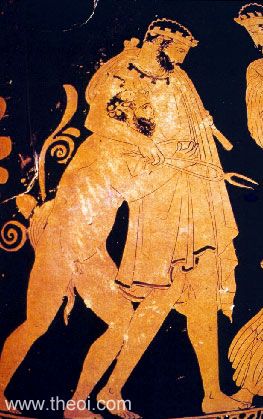
Homer, Odyssey 6. 233 & 23. 160 ff (trans. Shewring) (Greek epic C8th B.C.)
:
"As when a man adds gold to a silver vessel, a craftsman taught by Hephaistos and Athene to master his art
through all its range, so that everything that he makes is beautiful."
Hesiod, Theogony 864 ff (trans. Evelyn-White) (Greek epic C8th or 7th B.C.)
:
"Iron, though that is the strongest substance, melts under stress of blazing fire in the mountain forests
worked by handicraft of Hephaistos inside the divine earth."
Homeric Hymn 20 to Hephaestus (trans. Evelyn-White) (Greek epic C7th to 4th B.C.)
:
"Hephaistos famed for inventions (klytometis). With bright-eyed Athene he taught men glorious
crafts throughout the world,--men who before used to dwell caves in the mountains like wild beasts. But now that
they have learned crafts through Hephaistos the famed worker (klytotekhnes), easily they live a
peaceful life in their own houses the whole year round."
Solon, Fragment 13 (trans. Gerber, Vol. Greek Elegiac) (Greek elegy C7th to 6th B.C.)
:
"[One] who has learned the works of Athena and Hephaistos Polytekhnes (the god of many crafts) gathers in
his livelihood with his hands."
Antoninus Liberalis, Metamorphoses 11 (trans. Celoria) (Greek mythographer C2nd A.D.)
:
"Hephaistos had given him [Polytekhnos] an axe for his work as a carpenter."
Plato, Alcibiades 1. 121a (trans. Lamb) (Greek philosopher C4th B.C.) :
"[Sokrates, as the son of an Athenian potter, traces his ancestry back to the mythical artisan Daidalos and
the god Hephaistos :] `Mine [goes back] to Daidalos, and Daidalos to Hephaistos, son of Zeus!"
Plato, Protagoras 320c - 222a :
"The appointed hour was approaching when man in his turn was to go forth into the light of day; and
Prometheus, not knowing how he could devise his salvation, stole the mechanical arts of Hephaistos and Athene,
and fire with them (they could neither have been acquired nor used without fire), and gave them to man . . . he
entered by stealth into the common workshop of Athene and Hephaistos, in which they used to practise their
favourite arts, and carried off Hephaistos' art of working by fire, and also the art of Athene, and gave them to
man. And in this way man was supplied with the means of life."
Plato, Critias (trans Bury) :
"Hephaistos and Athene, who were brother and sister, and sprang from the same father, having a common
nature, and being united also in the love of philosophy and art, both obtained as their common portion this land
[Athens]."
Philostratus the Elder, Imagines 1. 6 (trans. Fairbanks) (Greek rhetorician C3rd
A.D.) :
"[From a description of an ancient Greek painting adorned with gemstones :] What abundance of sardonyx, of
emeralds, adorns them, and the pearls are true pearls; but the workmanship must be attributed to
Hephaistos!"
Suidas s.v. Khalkeia (trans. Suda On Line) (Byzantine Greek lexicon C10th A.D.)
:
"Khalkeia (Bronzes) : An ancient and popular festival long ago, but subsequently observed by the craftsmen
only, because Hephaistos [first] worked bronze in Attika."
Suidas s.v. Khalkeia :
"Khalkeia (Bronzes) : An Athenian festival . . . for craftsmen in general and bronze-smiths in particular,
as Apollonios says . . . the festival is celebrated . . . for Hephaistos."
Suidas s.v. Lampados :
"Lampados (Of a torch). And with torches. Athenians celebrate three torch-festivals, at [the] Panathenaia,
Hephaistia and Promethia. Istros says that having a torch-race was something [the] Athenians first did when
sacrificing to Hephaistos, to commemorate him who grasped the use of fire and taught it to others."
Suidas s.v. Aithaloeis theos :
"Aithaloeis theos (Sooty god) : Hephaistos, since [he is a] blacksmith. The same [god] is called
Klutotekhnes (famed-for-craft), since his skill at smithy-work is renowned."
For MYTHS of Hephaistos the craftsman-god see HEPHAESTUS WORKS
GOD OF VOLCANOES
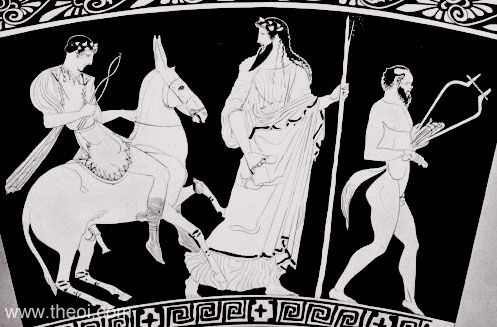
Hephaistos was later identified with the Italian volcano-god Adranus-Volcanus, and came to be regarded as the god of volcanoes. Originally the Greeks associated volcanic activity with the Gigante-sons of Gaia, rather than with Hephaistos.
Quintus Smyrnaeus, Fall of Troy 11. 100 ff (trans. Way) (Greek epic C4th A.D.)
:
"Korykia's ridge [in Lykia], and that great rock of the wise Fire-god [Hephaistos], marvellous in men's
eyes; for thereon, nightlong, daylong, unto him fire blazes, tireless and unquenchable [the Lykian volcano Mt
Khimaira]. Laden with fruit around it palm-trees grow, while mid the stones fire plays about their roots. Gods'
work is this, a wonder to all time."
Strabo, Geography 5. 4. 6 (trans. Jones) (Greek geographer C1st B.C. to C1st A.D.)
:
"Immediately above the city [of Baiae in Italia] lies the Forum of Hephaistos [Forum Volcania], a plain
shut in all round by exceedingly hot ridges, which in numerous places have fumaroles that are like chimneys and
that have rather noisome smell; and the plain is full of drifted sulphur."
Strabo, Geography 6. 2. 10 :
"Between Lipara and Sikelia (Sicily) is [the island of] Thermessa, which is now called Hiera of Hephaistos
[or Volcanus in Latin]; the whole island is rocky, desert, and fiery, and it has three fire blasts, rising from
three openings which one might call craters. From the largest the flames carry up also red-hot masses, which
have already choked up a considerable part of the Strait."
For MYTHS of Hephaistos (Adranus) as the god of Sicilian volcanoes see
Forge of Hephaestus on the Island Volcanus
IDENTIFIED WITH FOREIGN GODS
Hephaistos was identified with the Egyptian god Ptah and the Italian god Volcanos-Adranos.
Antoninus Liberalis, Metamorphoses 28 (trans. Celoria) (Greek mythographer C2nd A.D.)
:
"Typhon . . . felt an urge to usurp the rule of Zeus and not one of the gods could withstand him as he
attacked. In panic they fled to Aigyptos (Egypt) . . . When they fled they had changed themselves in
anticipation into animal forms . . . Hephaistos [became] an ox [i.e. the Egyptian god Ptah]."
Herodotus, Histories 2. 3. 1 (trans. Godley) (Greek historian C5th B.C.) :
"I also heard other things at Memphis [in Egypt] in conversation with the priests of Hephaistos [i.e. the
Egyptian god Ptah]."
Herodotus, Histories 2. 99. 4 :
"Built in it [Memphis in Egypt is a] . . . great and most noteworthy temple of Hephaistos [i.e. the
Egyptian god Ptah]."
Cicero, De Natura Deorum 1. 24 (trans. Rackham) (Roman rhetorician C1st B.C.)
:
"Volcanus [Hephaistos] has different names in Italy, in Africa and in Spain."
Cicero, De Natura Deorum 3. 22 :
"There are also several Volcanos' [Hephaistos']; the first, the son of Caelus [Ouranos], was reputedly the
father by Minerva [Athena] of the Apollo [Erikhthonios] said by the ancient historians to be the tutelary deity
of Athens; the second, the son of the Nile, is named by the Egyptians Phthas [Ptah], and is deemed the guardian
of Egypt; the third is the son of the third Jupiter [Zeus] and of Juno [Hera], and is fabled to have been the
master of a smithy at Lemnos; the fourth [the Italian god Adranus-Volcanus] is the son of Memalius, and lord of
the islands near Sicily which used to be named the Isles of Volcanus [the Lipari islands]."
Suidas s.v. Phthas (trans. Suda On Line) (Byzantine Greek lexicon C10th A.D.)
:
"Phthas : Hephaistos in Memphis."
SOURCES
GREEK
- Homer, The Iliad - Greek Epic C8th B.C.
- Homer, The Odyssey - Greek Epic C8th B.C.
- Hesiod, Theogony - Greek Epic C8th - 7th B.C.
- The Homeric Hymns - Greek Epic C8th - 4th B.C.
- Greek Elegaic Solon, Fragments - Greek Elegaic C6th B.C.
- Aeschylus, Agamemnon - Greek Tragedy C5th B.C.
- Aeschylus, Prometheus Bound - Greek Tragedy C5th B.C.
- Aristophanes, Birds - Greek Comedy C5th - 4th B.C.
- Herodotus, Histories - Greek History C5th B.C.
- Plato, Alcibiades - Greek Philosophy C4th B.C.
- Plato, Cratylus - Greek Philosophy C4th B.C.
- Plato, Critias - Greek Philosophy C4th B.C.
- Plato, Protagoras - Greek Philosophy C4th B.C.
- Strabo, Geography - Greek Geography C1st B.C. - C1st A.D.
- The Orphic Hymns - Greek Hymns C3rd B.C. - C2nd A.D.
- Antoninus Liberalis, Metamorphoses - Greek Mythography C2nd A.D.
- Philostratus the Elder, Imagines - Greek Rhetoric C3rd A.D.
- Quintus Smyrnaeus, Fall of Troy - Greek Epic C4th A.D.
ROMAN
- Ovid, Metamorphoses - Latin Epic C1st B.C. - C1st A.D.
- Cicero, De Natura Deorum - Latin Rhetoric C1st B.C.
- Seneca, Medea - Latin Tragedy C1st A.D.
BYZANTINE
- Suidas, The Suda - Byzantine Greek Lexicon C10th A.D.
BIBLIOGRAPHY
A complete bibliography of the translations quoted on this page.