DIONYSOS FAMILY
Greek Name
Διονυσος
Transliteration
Dionysos
Latin Spelling
Dionysus
Translation
Liber, Bacchus
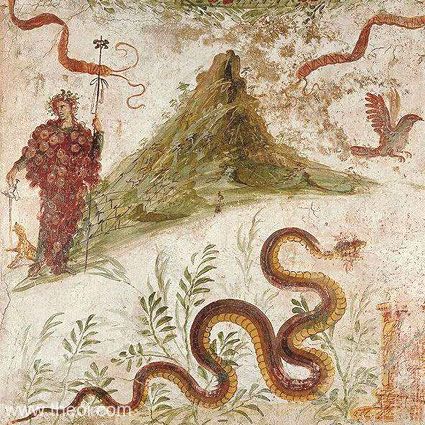
DIONYSOS was the Olympian god of wine, vegetation, pleasure, festivity, madness and frenzy.
This page provides an overview of the god's divine and mortal children. Most of these were linked to him with only the briefest genealogical reference. They were often assigned his paternity to emphasize their role as the founding kings and princes of important wine-producing regions.
The stories of Dionysos' liaisons are described separately on the "Loves" page.
(1) DIVINE OFFSPRING
HYMENAIOS (Hymenaeus) The god of weddings and the wedding hymn was sometimes called a son of Dionysos and Aphrodite. However he is usually described as Apollon's son by a Mousa.
IAKKHOS (Iacchus)A god of the Eleusinian Mysteries, known as the third Dionysos. He was a son of Dionysos and the Titaness Aura or Aphrodite.
KHARITES (Charites) The goddesses of the graces were sometimes called daughters of the god Dionysos. (Usually they were described as daughters of Zeus and Eurynome).
METHE The goddess-nymph of Drunkenness was a daughter of Dionysos.
PASITHEA The Kharis wife of Hypnos, god of sleep, was a daughter of Dionysos.
PRIAPOS (Priapus) The god of garden fertility. He was the son of Dionysos and Aphrodite or a Naiad Nymph.
SABAZIOS (Sabazius) A Thraco-Phrygian god of wine and vegetation who was closely identified with Dionysos. One classical author described him as a son of Dionysos.
TELETE The goddess of initiation into the Bacchic Mysteries. She was a daughter of Dionysos and the Nymphe Nikaia.
THYSA The goddess-nymph of the wild frenzy of the Bacchic orgy. She was a daughter of Dionysos.
(2) MORTAL OFFSPRING
DEIANEIRA A princess of Aitolia (central Greece), and the second wife of Herakles. She was a daughter of Dionysos (or King Oineus) and Althaia.
EURYMEDON A lord of Phlios in Sikyonia (outhern Greece) and one of the Argonauts. He was one of the sons of Dionysos and Ariadne.
KERAMOS (Ceramus) A lord of the Keramaikos "Potter's" district of Athens in Attika (douthern Greece). He was one of the sons of Dionysos and Ariadne.
MARON A priest of Apollon in Kikonia, Thrake (north of Greece). He entertained Odysseus on his return from the Trojan War and supplied him with a supply of wine. According to some he was a son of Dionysos (though he was usually called a great-grandson of the god: as a son of Euanthes, son of Oinopion, son of Dionysos).
NARKAIOS (Narcaeus) The first priest of Dionysos in Elis (southern Greece). He was the son of the god by a woman named Physkoa.
OINOPION (Oenopion) A king of the island of Khios (Greek Aegean). He was one of the sons of Dionysos and Ariadne.
PEPARETHOS (Peparethus) A king of the island of Peparethos (Greek Aegean). He was one of the many sons of Dionysos and Ariadne.
PHANOS An Argonaut from the island of Thasos (Greek Aegean). He was a son of Dionysos and Ariadne.
PHLIASOS or PHLIAS A lord of Phlios in Sikyonia (southern Greece) and one of the Argonauts. He was one of the sons of Dionysos and Ariadne.
STAPHYLOS (Staphylus) A king of Bubastos in Karia (Asia Minor) or the island of Thasos (Greek Aegean), and one of the Argonauts. He was one of the many sons of Dionysos and Ariadne.
THOAS A king of the island of Lemnos (Greek Aegean). He was a son of Dionysos and Ariadne.
GENEALOGICAL LISTING
OFFSPRING IMMORTAL
[1.1] PRIAPOS (by Aphrodite) (Pausanias 9.31.2, Diodorus Siculus 4.6.1)
[1.2] PRIAPOS (by a Naias Nymphe) (Strabo
8.587)
[1.3] PRIAPOS (by Khione) (Scholiast on
Theocritus 1.21)
[2.1] METHE (The Anacreontea Frag
38)
[3.1] THYSA (Euripides Palamedes frag, Strabo
10.3.13)
[4.1] TELETE (by Nikaia) (Nonnus Dionysiaca 16.392)
[5.1] IAKKHOS (by Aura) (Nonnus Dionysiaca 48.887)
[5.2] IAKKHOS (by Aphrodite)
(Orphic Hymn 57)
[6.1] PASITHEA (Nonnus Dionysiaca 15.87
& 33.37)
[7.1] KHARITES, THE (by Kronois or Hera) (Nonnus Dionysiaca 15.87 & 48.530)
[7.2] KHARITES, THE (The Anacreontea Frag
38)
[8.1] HYMENAIOS (Seneca Medea 110)
[9.1] SABAZIOS (Mnaseas of Patrae, Suidas s.v. Saboi)
OFFSPRING MORTAL
KINGDOM OF ATTIKA (Southern Greece)
[1.1] KERAMOS (by Ariadne) (Pausanias 1.3.1)
KINGDOM OF SIKYONIA (Southern Greece)
[1.1] PHLIAS (Pausanias 2.6.6)
[1.2] PHLIASOS, EURYMEDON (by Ariadne) (Hyginus Fabulae 14)
KINGDOM OF ELIS (in Southern Greece)
[1.1] NARKAIOS (by Physkoa) (Pausanias 5.16.6)
KINGDOM OF AITOLIA (Central Greece)
[1.1] DEIANEIRA (by Althaia) (Apollodorus 1.64, Hyginus Fabulae 129, Theophilus To Autolycus 7)
KINGDOM OF THASOS (Greek Aegean)
[1.1] STAPHYLOS (Apollodorus 1.113)
[1.2] STAPHYLOS (by Ariadne) (Apollodorus E1.9, Plutarch Theseus 20.2, Theophilus To Autolycus 7)
[2.1] PHANOS (Apollodorus 1.113)
KINGDOM OF KHIOS (Greek Aegean)
[1.1] OINOPION (Hesiod Catalogues of Women Frag 86)
[1.2] OINOPION (by Ariadne) (Anacreon Frag
505e, Apollodorus E1.9, Diodorus Siculus 5.79.1, Plutarch Theseus 20.2, Athenaeus 1.26b-c, Theophilus To
Autolycus 7)
KINGDOM OF LEMNOS (Greek Aegean)
[1.1] THOAS (by Ariadne) (Hesiod Catalogues
of Women Frag 85, Apollodorus E1.9, Apollonius Rhodius 4.425, Quintus Smyrnaeus 4.385)
[1.2] THOAS (Theophilus, To Autolycus 7)
KINGDOM OF PEPARETHOS (Greek Aegean)
[1.1] PEPARETHOS (by Ariadne) (Apollodorus E1.9)
KINGDOM OF KIKONIA, THRAKE (North of Greece)
[1.1] MARON (by Ariadne) (Theophilus To Autolycus 7)
KINGDOM OF BUBASTOS, KARIA (Anatolia)
[1.1] STAPHYLOS (Nicaenetus Lyrcus Frag, Apollonius Rhodius Caunus Frag, Parthenius Love Romances 1)
CLASSICAL LITERATURE QUOTES
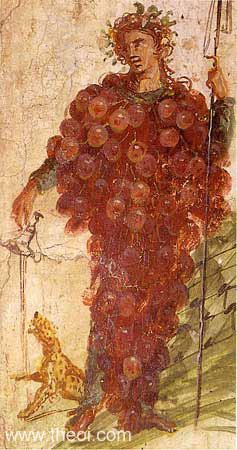
Cicero, De Natura Deorum 3. 21-23 (trans. Rackham) (Roman rhetorician C1st B.C.)
:
"We [the peoples of the Roman Empire] have a number of Dionysi [i.e. gods identified with Dionysos].
The first [the Orphic Zagreus] is the son of Jupiter [Zeus] and Proserpine [Persephone];
the second [the Egyptian Osiris] of Nile--he is the fabled slayer of Nysa.
The father of the third [Phrygian Sabazios] is Cabirus; it is stated that he was king over Asia, and the Sabazia
were instituted in his honour.
The fourth [the Thraco-Orphic Sabazios] is the son of Jupiter [Thrakian sky-god] and Luna [Bendis]; the Orphic
rites are believed to be celebrated in his honour.
The fifth [the Theban Dionysos] is the son of Nisus [Zeus] and Thyone [Semele], and is believed to have
established the Trieterid festival."
FAMILY NON-SPECIFIC LOCALE
LOVED : 1 - 2. Kronois, nymph; 3. Aphrodite.
FATHERED : 1. Kharites, goddesses of the graces; 2. Pasithea, goddess; 3. Hymenaios, god of marriage; 4. Methe,
goddess of drunkenness; 5. Thysa, goddess of Bacchic revels.
1 - 2) THE KHARITES and PASITHEA Goddess of the Graces
Anacreontea, Fragment 38 (trans. Campbell, Vol. Greek Lyric II) (Greek lyric B.C.)
:
"Thanks to him [Dionysos] . . . the Kharis (Grace) was born."
Colluthus, Rape of Helen 174 ff (trans. Mair) (Greek poetry C5th to 6th A.D.)
:
"They say that thou [Hera], mother of Ares, dist with travail bear the holy choir of fair-tressed Kharites
(Graces)."
Nonnus, Dionysiaca 48. 530 ff (trans. Rouse) (Greek epic C5th A.D.) :
"Of the love of Kronois [a Nymphe], from whose [Dionysos'] bed were born the three Kharites (Graces) ever
inseparable." [N.B. Kronois was a common epithet of the goddess Hera who is actually named as the mother of
the Kharites by Nonnus elsewhere.]
Nonnus, Dionysiaca 16. 130 ff :
"I [Dionysos] will present you with the Kharites (Graces) of divine Orkhomenos for servants, my
daughters."
Nonnus, Dionysiaca 15. 87 ff :
"Hypnos (Sleep) . . . doing grace to [the Kharis] Pasithea's father, Dionysos."
Nonnus, Dionysiaca 31. 103 ff :
"Pasithea's mother, Hera the handmaid of wedded love."
Nonnus, Dionysiaca 33. 4 ff :
"[The Kharis Pasithea addresses Aphrodite :] ‘I am tormented by the afflictions of Lyaios [Dionysos]
my father . . .’ She recounted all her father's afflictions."
For MORE information on these goddesses see KHARITES, PASITHEA
3) HYMENAIOS God of Marriage
Seneca, Medea 110 ff (trans. Miller) (Roman tragedy C1st A.D.) :
"Comely, noble scion [Hymenaios, god of weddings,] of Lyaeus [Dionysos] the thyrsos-bearer, now is the time
to light thy torch of frayed pinewood."
For MORE information on this god see HYMENAIOS
4) METHE Goddess of Drunkeness
Anacreontea, Fragment 38 (trans. Campbell, Vol. Greek Lyric II) (Greek lyric B.C.)
:
"Thanks to him [Dionysos] Methe (Drunkeness) was brought forth."
For MORE information on this goddess-nymph see METHE
5) THYSA Goddess of Bacchic Revels
Strabo, Geography 10. 3. 13 (trans. Jones) (Greek geographer C1st B.C. to C1st A.D.)
:
"And in the Palamedes [of Euripides] the Chorus says, ‘Thysa, daughter of Dionysos, who on
Ida rejoices with his dear mother in the Iakkhic revels of tambourines.’"
For MORE information on this goddess-nymph see THYSA
FAMILY IN ATTICA (SOUTHERN GREECE)
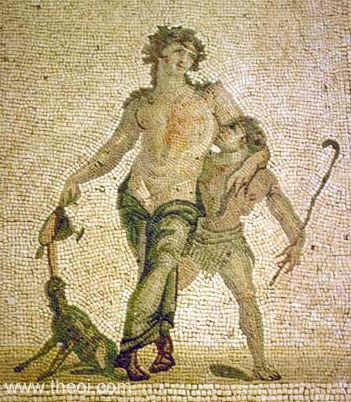
FATHERED : 1. Keramaikos, Athenian lord.
Pausanias, Description of Greece 1. 3. 1 (trans. Jones) (Greek travelogue C2nd A.D.)
:
"The district of the Kerameikos (Of the Potters) has its name from the hero Keramos, he too being the
reputed son of Dionysos and Ariadne."
N.B. The Kerameikos district of Athens was the site of the Athenian pottery industry. Some of the most important products included storage jars for wine and drinking cups. For this reason it was probably associated with the god of wine, Dionysos.
FAMILY IN SICYONIA (SOUTHERN GREECE)
FATHERED : 1. Phlias, lord of Phlios; 2. Eurymedon, lord of Phlios.
Pausanias, Description of Greece 2. 6. 6 (trans. Jones) (Greek travelogue C2nd A.D.)
:
"Sikyon [king of Sikyon] had a daughter Khthonophyle . . . she married Phlias, the son of Dionysos."
Pseudo-Hyginus, Fabulae 14 (trans. Grant) (Roman mythographer C2nd A.D.) :
"Argonauts Assembled . . . Phliasus, son of Father Liber [Dionysos] and Ariadne, daughter of Minos, from
the city Phlius, which is in the Peloponnese. Others call him a Theban."
Pseudo-Hyginus, Fabulae 14 :
"Argonauts Assembled . . . Eurymedon, son of Father Liber [Dionysos] and Ariadne, daughter of Minos, from
Phlius."
N.B. The region of Phliasia was famed for its vineyards and wine, hence its eponym was named as a son of the god of wine.
For MYTH of Dionysos and his sons see Dionysus Favour: Bacchides
FAMILY IN ELIS (SOUTHERN GREECE)
LOVED : 1. Physkoa, lady of Orthia in Elis.
FATHERED : 1. Narkaios, priest of Dionysos at Olympia.
Pausanias, Description of Greece 5. 16. 7 (trans. Jones) (Greek travelogue C2nd A.D.)
:
"Physkoa they say came [to Olympia] from Elis in the Hollow, and the name of the parish where she lived was
Orthia. She mated they say with Dionysos, and bore him a son called Narkaios. When he grew up he made war
against the neighboring folk, and rose to great power, setting up moreover a sanctuary of Athena surnamed
Narkaia. They say too that Narkaios and Physkoa were the first to pay worship to Dionysos [in Elis]."
FAMILY IN AETOLIA (CENTRAL GREECE)
LOVED : 1. Althaia, queen of Kalydon.
FATHERED : 1. Deianeira, princess of Kalydon.
Pseudo-Apollodorus, Bibliotheca 1. 64 (trans. Aldrich) (Greek mythographer C2nd A.D.)
:
"Oineus . . . married Thestios' daughter Althaia, he was the father of . . . Deianeira, whose father some
say was Dionysos."
Pseudo-Hyginus, Fabulae 129 (trans. Grant) (Roman mythographer C2nd A.D.)
:
"Liber [Dionysos] lay with Althaea, who became mother of Dejanira."
Theophilus of Antioch, To Autolycus 7 (Greek Christian epistles C2nd A.D.)
:
"In the Dionysian tribe [i.e. those claiming descent from the god] there are distinct families: the
Althaian from Althaia, who was the wife of Dionysos and daughter of Thestios; the family of Deianeira also, from
her who was the daughter of Dionysos and Althaia, and wife of Herakles."
For the MYTH of the god's love for Althaia see Dionysus Loves: Althaea
FAMILY IN NAXOS (GREEK AEGEAN)
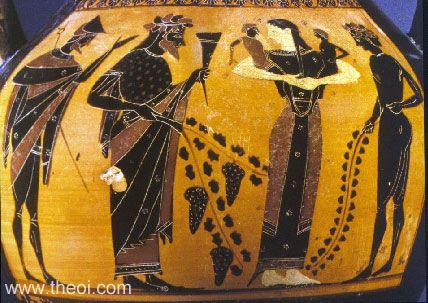
LOVED : 1. Ariadne, princess of Krete (abandoned by Theseus on Naxos).
Pseudo-Apollodorus, Bibliotheca E1. 9 (trans. Aldrich) (Greek mythographer C2nd A.D.)
:
"Dionysos fell in love with Ariadne, and kidnapped her [from Naxos], taking her off to Lemnos where he had
sex with her, and begat Thoas, Staphylos, Oinopion, and Peparethos."
Plutarch, Life of Theseus 20. 1 (trans. Perrin) (Greek historian C1st to C2nd A.D.)
:
"Some say that Ariadne actually had sons by Theseus, Oinopion and Staphylos, and among these is Ion of
Khios . . . Some of the Naxians also have a story of their own . . . they say, [Ariadne] was married to Dionysos
in Naxos and bore him Staphylos and his brother [Oinopion]."
The sons of Dionysos and Ariadne were kings of several islands in the North Aegean: Thoas in Lemnos, Staphylos in Thasos, Peparethos in Peparethos and the, and Oinopion in Khios.
For the MYTH of the god's marriage to Ariadne see Dionysus Loves: ARIADNE
FAMILY IN THASOS (GREEK AEGEAN)
FATHERED : 1. Staphylos, king of Thasos; Phanos, lord of Thasos?
Pseudo-Apollodorus, Bibliotheca 1. 113 (trans. Aldrich) (Greek mythographer C2nd
A.D.) :
"The Argonauts: . . . Phanos and Staphylos, sons of Dionysos."
Suidas s.v. Enekheis (quoting Aristophanes, Plutus 1020) (trans. Suda On Line)
(Byzantine Greek lexicon C10th A.D.) :
"Staphylos, the beloved of Dionysos, lived on Thasos; and because of this Thasian wine is
distinctive."
N.B. The island of Thasos was an important producer of wines, and so its eponym was named a son of the god of wine.
For Stayphylus see Family in Caria
For MYTH of Dionysos and his sons see Dionysus Favour: Bacchides
FAMILY IN CHIOS (GREEK AEGEAN)
FATHERED : 1. Oinopion, king of Khios.
Hesiod, Catalogues of Women Fragment 86 (from Eustathius on Homer 1623) (trans.
Evelyn-White) (Greek epic C8th or 7th B.C.) :
"Maro, whose father, it is said, Hesiod relates to have been Euanthes the son of Oinopion, the son of
Dionysos."
Anacreon, Fragment 505e (Scholiast on Aratus) (trans. Campbell, Vol. Greek Lyric II)
(C6th B.C.) :
"Oinopion son of Dionysos and Ariadne."
Pseudo-Apollodorus, Bibliotheca E1. 9 (trans. Aldrich) (Greek mythographer C2nd A.D.)
:
"Dionysos fell in love with Ariadne, and kidnapped her [from Naxos], taking her off to Lemnos where he had
sex with her, and begat . . . Oinopion."
Diodorus Siculus, Library of History 5. 79. 1 (trans. Oldfather) (Greek historian
C1st B.C.) :
"To Oinopion, the son of Minos's daughter Ariadne, he [Rhadamanthys] gave [the island of] Khios."
Plutarch, Life of Theseus 20. 1 (trans. Perrin) (Greek historian C1st to C2nd A.D.)
:
"Some say that Ariadne actually had sons by Theseus, Oinopion and Staphylos, and among these is Ion of
Khios, who says of his own native city :--‘This, once, Theseus's son founded, Oinopion’ . . .
Some of the Naxians also have a story of their own . . . they say, [Ariadne] was married to Dionysos in Naxos
and bore him Staphylos and his brother [Oinopion]."
Athenaeus, Deipnosophistae 1. 26b-c (trans. Gullick) (Greek rhetorician C2nd to 3rd
A.D.) :
"The Khians were the first to learn how to plant and tend vines from Oinopion, son of Dionysos, who also
was the founder of that island-state."
N.B. The island of Khios was famed for its vineyards and wines.
For MYTH of Dionysos and Oinopion see Dionysus Favour: Bacchides
FAMILY IN LEMNOS (GREEK AEGEAN)
FATHERED : 1. Thoas, king of Lemnos; 2. Euneus, king of Lemnos.
Hesiod, Catalogues of Women Fragment 85 (from Choeroboscus 1.123) (trans.
Evelyn-White) (Greek epic C8th or 7th B.C.) :
"And she bare a son Thoas." [N.B. She is presumably Ariadne, and the father Dionysos.]
Pseudo-Apollodorus, Bibliotheca E1. 9 (trans. Aldrich) (Greek mythographer C2nd A.D.)
:
"Dionysos fell in love with Ariadne, and kidnapped her [from Naxos], taking her off to Lemnos where he had
sex with her, and begat Thoas, Staphylos, Oinopion, and Peparethos."
Apollonius Rhodius, Argonautica 4. 425 ff (trans. Rieu) (Greek epic C3rd B.C.)
:
"Dionysos . . . his son Thoas . . . [by] Minos' daughter, the fair young Ariadne."
Quintus Smyrnaeus, Fall of Troy 4. 430 ff (trans. Way) (Greek epic C4th A.D.)
:
"Dionysos ... his bride divine [Ariadne], Minos' child far-famous . . . [their] son Thoas."
Theophilus of Antioch, To Autolycus 7 (Greek Christian epistles C2nd A.D.)
:
"In the Dionysian tribe there are distinct families . . . [each of these] families have their names [from a
founding son of Dionysos] . . . the family of Ariadne, from Ariadne, daughter of Minos and wife of Dionysos . .
. the Thoantian, from Thoas, son of Dionysos . . . the Euainian, from Euneus, son [usually great-grandson] of
Dionysos."
N.B. Lemnos was a wine-producing island.
For MYTH of Dionysos and Thoas see Dionysos Favour: Bacchides
FAMILY IN PEPARETHOS (GREEK AEGEAN)
FATHERED : 1. Peparethos, king of Peparethos.
Pseudo-Apollodorus, Bibliotheca E1. 9 (trans. Aldrich) (Greek mythographer C2nd A.D.)
:
"Dionysos fell in love with Ariadne, and kidnapped her [from Naxos], taking her off to Lemnos where he had
sex with her, and begat Thoas, Staphylos, Oinopion, and Peparethos."
N.B. The island of Peparethos was an exporter of--reputedly low quality--wine.
For MYTH of Dionysos and Peparethos see Dionysus Favour: Bacchides
FAMILY IN PALLENE, THRACE (NORTH OF GREECE)
LOVED : 1. Pallene, princess of Sithonia-Pallene.
For the MYTH of the god's love for Pallene see Dionysus Loves: Pallene
FAMILY IN CICONIA, THRACE (NORTH OF GREECE)
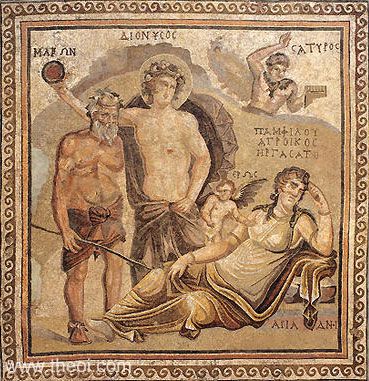
FATHERED : 1. Maron, priest of Dionysos in Kikonia.
Theophilus of Antioch, To Autolycus 7 (Greek Christian epistles C2nd A.D.)
:
"In the Dionysian tribe there are distinct families . . . [each of these] families have their names [from a
founding son of Dionysos] . . . the Maronian, from Maron, son of Ariadne and Dionysos [actually his
great-grandson, son of Euanthes, son of Oinopion, son of Dionysos]."
FAMILY IN CARIA (ANATOLIA)
FATHERED : 1. Staphylos, king of Bubastos.
Pseudo-Apollodorus, Bibliotheca 1. 113 (trans. Aldrich) (Greek mythographer C2nd
A.D.) :
"The Argonauts: . . . Phanos and Staphylos, sons of Dionysos."
Pseudo-Apollodorus, Bibliotheca E1. 9 :
"Dionysos fell in love with Ariadne, and kidnapped her [from Naxos], taking her off to Lemnos where he had
sex with her, and begat Thoas, Staphylos, Oinopion, and Peparethos."
Parthenius, Love Romances 1 (trans. Gaselee) (Greek poet C1st B.C.) :
"From the Lyrkos of Nikainetos and the Kaunos of Apollonios Rhodios [two Alexandrian
Greek poets C3rd B.C.]: . . . [Lyrkos] arrived at Bybastos [in Karia, Anatolia], he was entertained by
Staphylos, the son of Dionysos, who received him in the most friendly manner and enticed him to much drinking of
wine."
Theophilus of Antioch, To Autolycus 7 (Greek Christian epistles C2nd A.D.)
:
"In the Dionysian tribe there are distinct families . . . [each of these] families have their names [from a
founding son of Dionysos] . . . the family of Ariadne, from Ariadne, daughter of Minos and wife of Dionysos . .
. the Staphylian, from Staphylos, son of Dionysos."
Suidas s.v. Enekheis (quoting Aristophanes, Plutus 1020) (trans. Suda On Line)
(Byzantine Greek lexicon C10th A.D.) :
"Staphylos, the beloved of Dionysos, lived on Thasos; and because of this Thasian wine is
distinctive."
AMILY IN MYSIA (ANATOLIA)
LOVED : 1. Aphrodite, goddess of love; 1. Unnamed Nymphe, of Lampsakos.
FATHERED : 1. Priapos, vegetation god of Lampsakos.
Strabo, Geography 13. 1. 12 (trans. Jones) (Greek geographer C1st B.C. to C1st A.D.)
:
"The inhabitants [of the town of Priapos in Mysia] felt an impulse to worship the god [Priapos] because he
was called the son of Dionysos and a Nymphe; for their country is abundantly supplied with the vine."
Pausanias, Description of Greece 9. 31. 1 (trans. Jones) (Greek travelogue C2nd A.D.)
:
"By the people of Lampsakos he [Priapos] is more revered than any other god, being called by them a son of
Dionysos and Aphrodite."
For the MYTH of the god's love for Aphrodite see Dionysus Loves: Aphrodite
For MORE information on the god Priapos see PRIAPOS
FAMILY IN BITHYNIA OR PHRYGIA (ANATOLIA)
LOVED : 1. Nikaia, Phrygian nymph; 2. Aura, Phrygian titaness.
FATHERED : 1. Telete, goddess of initiation; 2. Iakkhos, god of the mysteries; 3. Sabazios, Phrygian god.
1) TELETE Goddess of Initiation Rites
Nonnus, Dionysiaca 16. 392 ff (trans. Rouse) (Greek epic C5th A.D.) :
"Now lined with the divine dew, the seed of Lyaios [Dionysos], she [Nikaia] carried a burden in her womb .
. . From the marriage of Bromios [Dionysos] a god-sent girl grew to flower, whom she named Telete
(Consecration), one ever rejoicing in festivals, a night-dancing girl, who followed Dionysos, taking pleasure in
clappers and the bang of the double oxhide."
For the MYTH of the love of Dionysos and Nikaia see Dionysus Loves: Nicaea
For MORE information on this minor goddess see TELETE
2 - 3) IAKKHOS-SABAZIOS Mystery and Phrygian gods
Suidas s.v. Saboi (trans. Suda On Line) (Byzantine Greek lexicon C10th A.D.)
:
"They say that Sabazios and Dionysos are the same . . . But Mnaseas of Patrai [poet C3rd B.C.] says that
Sabazios is the son of Dionysos."
Orphic Hymn 57 to Chthonian Hermes (trans. Taylor) (Greek hymns C3rd B.C. to 2nd
A.D.) :
"O Bakkheios Hermes [probably Iakkhos], progeny divine of Dionysos, parent of the vine, and of celestial
Aphrodite, Paphian queen, dark-eyelashed Goddess, of a lovely mien."
Nonnus, Dionysiaca 48. 848 ff (trans. Rouse) (Greek epic C5th A.D.) :
"A babe came quickly into the light [born by the Titanis Aura to Dionysos] . . . the womb of Aura was
loosened, and twin children [Iakkhos and his brother] came forth of themselves."
N.B. Iakkhos in Nonnus is apparently the Phrygian god Sabazios.
For the MYTH of the love of the god and Aura see Dionysus
Loves: Aura
For MORE information on this minor god see IAKKHOS
DIONYSUS & THE NOBLE HOUSES OF GREECE (HISTORICAL)
A number of historical Greek royal and noble families claimed descent from Dionysos. His various mythical sons were the founders and namesakes of these houses, such as the Thoantian (for Thoas), the Staphylian (for Staphylos) and the Maronian (for Maron).
The ancestry of the Ptolemaic dynasty of Egypt was also traced back to Dionysos (over 25 generations):
Dionysos -- Deianeira --- Hyllos -- Kleodemos -- Aristomakhos -- Temenos -- Keisos -- Maron -- Thestros -- Akous
-- Aristomidas -- Karanos -- Koinos -- Tryimmas -- Perdikkhas -- Phillippos -- Aeropos -- Alketas -- Amyntas --
Bokros -- Meleagros -- Arsinoe -- Lagos Ptolemy Soter -- Ptolemy Euergetes -- Ptolemy Philopater
Theophilus of Antioch, To Autolycus 7 (Greek Christian epistles C2nd A.D.)
:
"Satyros [ancient Greek historian], also giving a history of the Alexandrine families, beginning from
Philopator, who was also named Ptolemy, gives out that Bakkhos [Dionysos] was his progenitor; wherefore also
Ptolemy was the founder of this family. Satyros then speaks thus: That Deianeira was born of Bakkhos and
Althaia, the daughter of Thestios; and from her and Herakles the son of Zeus there sprang, as I suppose, Hyllos;
and from him Kleodemos, and from him Aristomakhos, and from him Temenos, and from him Keisos, and from him
Maron, and from him Thestros, and from him Akous, and from him Aristomidas, and from him Karanos, and from him
Koinos, and from him Tyrimmas, and from him Perdikkhas, and from him Philippos, and from him Aeropos, and from
him Alketas, and from him Amyntas, and from him Bokros, and from him Meleagros, and from him Arsinoe, and from
her and Lagos Ptolemy Soter, and from him and Arsinoe Ptolemy Euergetes, and from him and Berenike, daughter of
Maga, king of Kyrene, Ptolemy Philopator. Thus, then, stands the relationship of the Alexandrine kings to
Bakkhos. And therefore in the Dionysian tribe there are distinct families: the Althaian from Althaia, who was
the wife of Dionysos and daughter of Thestios; the family of Deianeira also, from her who was the daughter of
Dionysos and Althaia, and wife of Herakles;--whence, too, the families have their names: the family of Ariadne,
from Ariadne, daughter of Minos and wife of Dionysos, a dutiful daughter, who had intercourse with Dionysos in
another form; the Thestian, from Thestios, the father of Althaia; the Thoantian, from Thoas, son of Dionysos;
the Staphylian, from Staphylos, son of Dionysos; the Euainian, from Eunous, son [great-grandson] of Dionysos;
the Maronian, from Maron, son [great-grandson] of Ariadne and Dionysos;--for all these are sons of
Dionysus."
[N.B. this passage is from an early Christian scholar's critique of the pagan religion.]
Suidas s.v. Attalos (trans. Suda On Line) (Byzantine Greek lexicon C10th A.D.)
:
"Attalos [King of Pergamon C3rd B.C.]. The Pythia was proved right about him, for in delivering an oracle
to Attalos the Great she said, ‘Be of good heart, bull-horned one.’ [i.e. he was named bull-horned
because the Attalides claimed to be descended from the bull-horned Dionysos]."
Suidas s.v. Bakkhides :
"Bakkhidês : The son of Dionysos [or descendant]."
SOURCES
GREEK
- Hesiod, Catalogues of Women Fragments - Greek Epic C8th - 7th B.C.
- Greek Lyric I Terpander, Fragments - Greek Lyric C7th B.C.
- Greek Lyric II Anacreontea, Fragments - Greek Lyric C5th - 4th B.C.
- Apollodorus, The Library - Greek Mythography C2nd A.D.
- Apollonius Rhodius, The Argonautica - Greek Epic C3rd B.C.
- Parthenius, Love Romances - Greek Mythography C1st B.C.
- Diodorus Siculus, The Library of History - Greek History C1st B.C.
- Strabo, Geography - Greek Geography C1st B.C. - C1st A.D.
- Pausanias, Description of Greece - Greek Travelogue C2nd A.D.
- Plutarch, Lives - Greek Historian C1st - 2nd A.D.
- The Orphic Hymns - Greek Hymns C3rd B.C. - C2nd A.D.
- Athenaeus, Deipnosophistae - Greek Rhetoric C3rd A.D.
- Theophilus, To Autolycus - Chrisitan Scholar C2nd A.D.
- Quintus Smyrnaeus, Fall of Troy - Greek Epic C4th A.D.
- Nonnus, Dionysiaca - Greek Epic C5th A.D.
- Colluthus, The Rape of Helen - Greek Epic C5th - 6th A.D.
ROMAN
- Hyginus, Fabulae - Latin Mythography C2nd A.D.
- Cicero, De Natura Deorum - Latin Rhetoric C1st B.C.
- Seneca, Medea - Latin Tragedy C1st A.D.
BYZANTINE
- Suidas, The Suda - Byzantine Greek Lexicon C10th A.D.
BIBLIOGRAPHY
A complete bibliography of the translations quoted on this page.